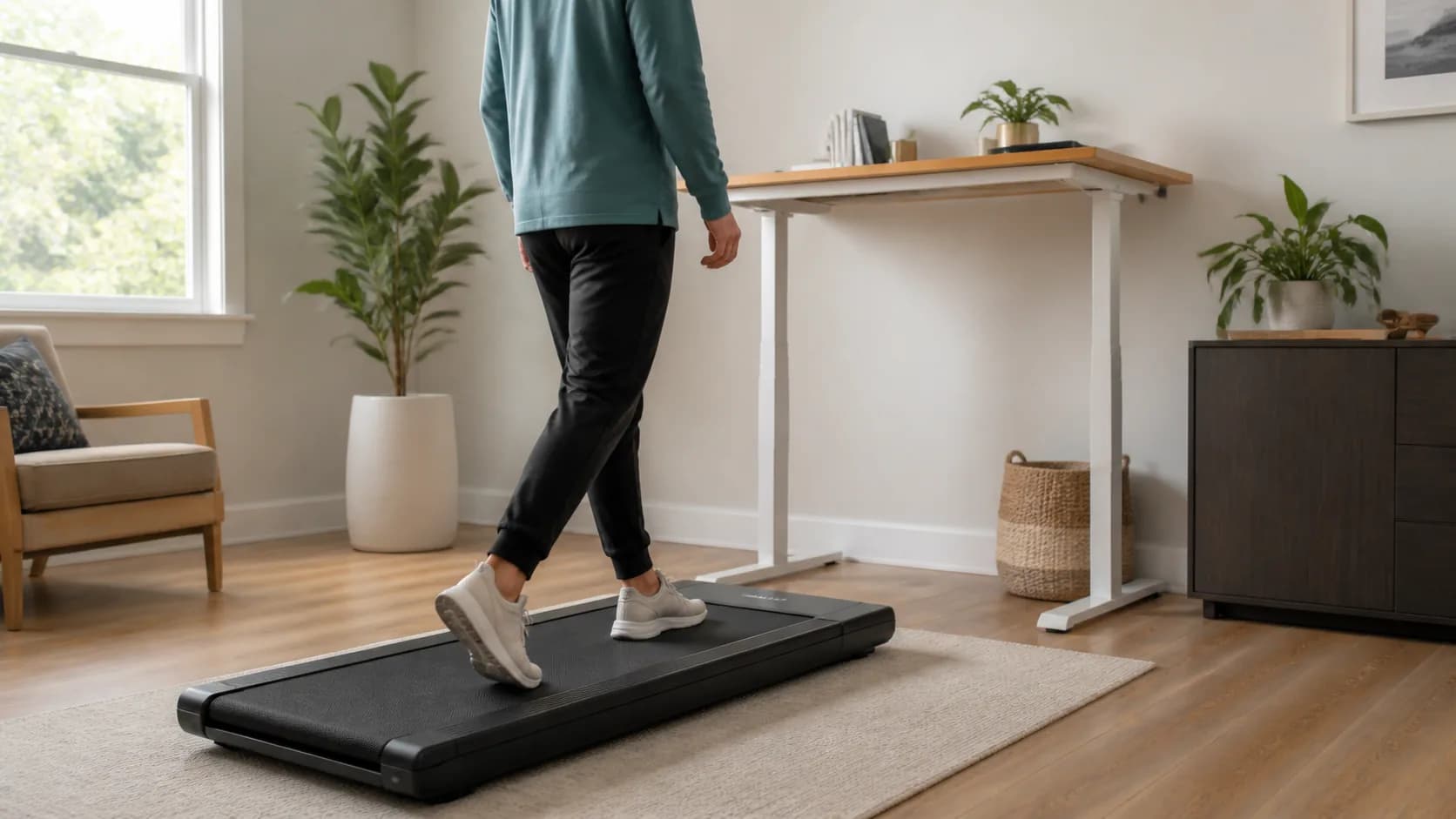
Many office workers take fewer steps than they expect, but there is no single average that tells you whether your day is “good” or “bad.” Your commute, whether you work remotely, the size of your workplace, caregiving, lunch routine, weather, and tracker all change the total. An office job also includes more than steps: long uninterrupted sitting can be a separate habit worth noticing.
A useful response is not to set an arbitrary 10,000-step target tomorrow. First see your real baseline, then build small movement breaks and one purposeful walk into the parts of the day you can control.
What research suggests about desk-heavy work
A systematic review of device-measured activity across occupations found that office workers had lower step counts and substantially more sedentary time than more active occupational groups. In that review, office workers averaged roughly 6,857 daily steps, but that figure is a study-level estimate—not a target and not necessarily representative of a particular country, company, or hybrid-work pattern.
Remote work can change the picture further. A newer review comparing home and on-site work reported lower daily steps and more sedentary time when working from home, although the studies varied and many were conducted during the COVID-19 period. The takeaway is practical: the accidental movement of commuting, walking between rooms, and going out for lunch may disappear from a home-based day.
Use your own week as the reference
Track a normal workweek before changing anything. Do not try to win the experiment. Notice your total steps, but also record when you stood up and whether you took a purposeful walk. A weekday may show 3,000 steps even if you fit in a workout; another may show 7,000 mostly through errands. Context makes the number useful.
| Workday pattern | Low-friction movement option |
|---|---|
| Back-to-back video calls | Stand or walk for two minutes between calls; take one call audio-only if appropriate. |
| Commute disappears at home | Walk around the block at the start or end of the workday to create a transition. |
| Lunch at the desk | Take a 10-minute walk before or after eating. |
| Long focus session | Set a timer for a brief movement or water break. |
| Bad weather or unsafe route | Use stairs, a hallway, a mall, or a short indoor loop. |
You do not have to count every movement break as an exercise session. Their value is that they reduce the all-day pattern of remaining in one position and make a larger walking habit easier to start.
Start with minutes, then observe steps
The U.S. Physical Activity Guidelines emphasize weekly moderate-to-vigorous activity, not a mandatory daily step count. A 10-minute walk is concrete and easy to schedule. Once you see how many steps it adds on your own device, you can use that information to set a realistic step goal.
Try this three-part design for a typical desk day:
- Arrival walk: five to ten minutes before you open work messages.
- Midday reset: a short walk after lunch or during a call that does not require a screen.
- Closing walk: five minutes after work to create a boundary between desk time and home time.
If that adds up to 20 minutes but the total still is not a round number, it has still changed the day in a useful way. Keep the routine stable before making it longer or faster.
Avoid the “weekend rescue” pattern
A long Saturday walk can be enjoyable, but it does not make weekdays irrelevant. Try to distribute some movement across the week. That may be three five-minute breaks on office days plus a longer weekend route. Consistent, manageable action is usually more sustainable than feeling you must repair a sedentary week with one punishing session.
Walking also does not replace strength work. If your goal includes maintaining muscle and physical function, plan two manageable strength sessions each week in addition to your walking. They can be brief and home-based; the right format depends on your experience and health needs.
Design the workday around real constraints
The most useful office-walking plan is shaped around the moments that already exist in your calendar. “Walk more” is vague; “walk after the 11:30 meeting on Tuesday and Thursday” is an instruction you can follow. Look for transitions rather than empty time. The first five minutes after a call, the period before lunch, the end of the workday, and the walk to collect a drink are often easier to protect than a new 45-minute appointment.
Workplace culture matters too. Some people can take a walking call; others must stay at a desk, serve customers, monitor a system, or work in a shared space. A good plan does not assume everyone can leave at the same time. If getting outdoors is impractical, a few loops through a safe hallway or a set of stairs may be the available option. If standing breaks are not possible during a task, use the transition after it instead.
Think in “anchors” and “fallbacks.” An anchor is the usual cue: after lunch, walk for ten minutes. A fallback protects the habit when that cue fails: if lunch is booked, take a five-minute loop before the first afternoon meeting. This is more forgiving than aiming for a perfect total and abandoning the plan at 4 p.m. because the morning was unusually busy.
A gradual four-week office routine
Use this as a template, not a prescription. Keep each increase only if it feels tolerable and fits your work responsibilities.
| Week | Focus | Example action |
|---|---|---|
| 1 | Learn the baseline | Carry your usual device and note the easiest time for one short break. |
| 2 | Add one anchor | Take a five- to ten-minute walk after lunch on three workdays. |
| 3 | Add a second cue | Include a brief beginning- or end-of-day loop on two days. |
| 4 | Review, do not automatically increase | Keep what worked; change the route, time, or goal only if it remains comfortable. |
This approach makes it easier to see cause and effect. If your steps rose but you also became rushed or your feet became sore, the plan may need a smaller increase or a different time of day. If one walk is consistently skipped, that is useful information about the cue—not a personal failure.
Separate step goals from workstation care
Walking breaks can be helpful, but they do not by themselves solve an uncomfortable desk setup, repetitive strain, visual fatigue, or an excessive workload. Adjusting a chair, screen, keyboard, or work pattern may call for a manager, occupational-health resource, ergonomic professional, or clinician. It is better to treat those as related but distinct issues than to promise that a step target will fix them.
Similarly, avoid using a movement reminder as a reason to push through new pain, dizziness, numbness, shortness of breath, or a medical restriction. The right action may be to stop, rest, and seek individual guidance. On ordinary low-energy days, however, an easy short walk can be a lower-pressure alternative to deciding that the whole week is lost.
Review the pattern each Friday
At the end of a week, ask a few practical questions: Which day had the lowest count, and why? Did meetings, weather, commute changes, or family logistics explain it? Which walk felt easiest to repeat? Did the goal make you take a useful break, or did it become another source of pressure? A weekly review turns the tracker into a planning tool instead of a daily verdict.
If your work schedule changes from office to home or from day to night shifts, expect the baseline to change too. Re-run the observation week rather than holding yourself to an old number. The aim is a reliable movement rhythm inside the workday you actually have.
Let tracking support, rather than police, the habit
Stepsly (opens in a new tab) is an iPhone step counter that uses Apple Health data to show daily steps, goals, history, and widgets. It can make an office-day baseline and a small walking goal visible. It cannot tell whether your posture, workstation, workload, or recovery is ideal.
Use a minimum and a full version of the plan. The minimum might be one five-minute outdoor or indoor break. The full version might be a lunch walk plus two short breaks. This gives you a way to keep the habit on deadline-heavy days without treating a low count as failure.
See how many steps does the average person take?, how many steps do nurses walk per shift?, and walking 45 minutes a day. The daily step-goal tool can turn your baseline into a gradual target.
Sources, notes & disclaimers
-
Planning doses use the Physical Activity Guidelines for Americans (opens in a new tab): 150–300 moderate weekly minutes plus strength work on 2 days for most adults who can safely do so.
-
Occupational activity systematic review and meta-analysis (opens in a new tab) reported lower average daily steps for office workers than other occupational groups in the included studies.
-
Working from home and activity systematic review (opens in a new tab) summarizes observed changes in sedentary time and daily steps; results varied across studies.
-
CDC adult activity overview (opens in a new tab) summarizes weekly activity guidance.
-
This article is general education, not medical or ergonomic advice. Discuss pain, dizziness, work restrictions, or a new exercise program with an appropriate clinician or workplace professional.