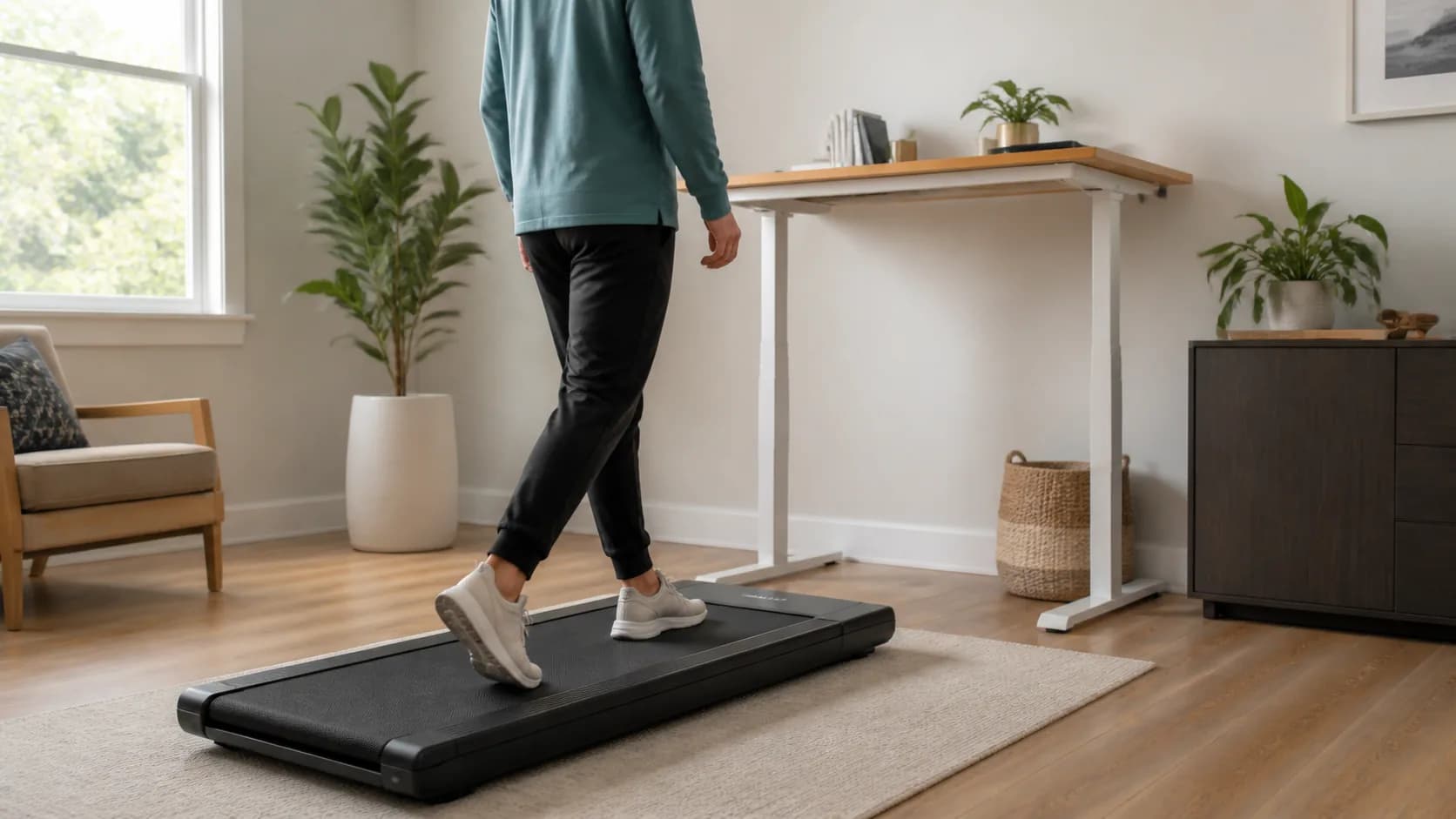
Walking pads can be a practical way to add low-speed movement at home, especially for people who spend long periods at a desk. Their main benefit is not a secret calorie trick. It is making short, frequent walks more convenient.
They are not a replacement for outdoor walking, strength work, or a full exercise program. They are a tool for reducing long stretches of sitting when a traditional walk is inconvenient.
What a walking pad is good for
| Goal | How a walking pad can help | What it cannot guarantee |
|---|---|---|
| More daily movement | Makes short indoor walks easy to start. | A specific daily step total. |
| Desk breaks | Creates a low-barrier alternative to sitting still. | Focus or comfort during every task. |
| Bad-weather routine | Gives you an indoor option. | The benefits of outdoor light or varied terrain. |
| Consistency | Lets you accumulate small sessions. | Weight loss without broader habits. |
The safest way to begin
Start off the pad, not at your work desk. Learn its controls and walking feel at a slow pace with full attention. Once you are comfortable, try 10-minute sessions before deciding whether you can read, take calls, or type while moving.
Keep speed low enough that your posture stays natural. Work that requires precision, frequent mouse movements, or deep concentration may be better done sitting or standing still.
A desk-walking day that does not take over your job
| Moment | Movement plan |
|---|---|
| Before work | 10 minutes easy to establish the habit. |
| Mid-morning | 5–10 minutes during a low-focus task or break. |
| Lunch | A separate 10–20 minute walk away from the desk if possible. |
| Mid-afternoon | 5 minutes to break up sitting. |
| After work | Optional easy walk to unwind. |
Small sessions can add up. They also give your eyes, posture, and attention a reset—provided you choose tasks that remain safe while walking.
Buying and setup considerations
Check the walking surface length, stated user-weight limit, noise, storage needs, remote or safety-stop design, and warranty. Use stable footwear and keep pets, children, cables, and loose rugs away from the belt. Never assume a compact device is safe to use unattended.
If you feel unsteady, have a fall risk, or use a mobility aid, get individualized advice before adding a moving belt to your workday.
Track the habit, not only the total
The first useful metric is often how often you take a movement break. Stepsly can show your daily progress, history, trends, and goal streaks through Apple Health data. Let that feedback encourage realistic consistency rather than turning desk walking into another number to chase.
For another desk-friendly plan, see creative ways to get more steps at a desk job, how to incorporate walking into your daily routine, and the Daily Step Goal Calculator.
Separate walking from desk work at first
The safest first use is a walking session with no laptop, phone call, or task competing for attention. Learn how the belt starts and stops, whether your feet land near the center, and what speed lets you turn your head without losing balance. Only then should you test a low-demand activity such as listening to a meeting or reading a simple document.
| Task | Usually sensible while moving? | Why |
|---|---|---|
| A short phone call with headphones | Possibly, after practice. | It can be low-demand if the pace is slow and surroundings are clear. |
| Reading a complex document | Often better seated. | Eye and attention demands can make posture less stable. |
| Detailed typing, spreadsheets, or design work | Usually not at first. | Fine motor work invites awkward reach and divided attention. |
| Video meeting where you present | Usually not. | Camera, attention, and body stability are competing tasks. |
| A scheduled movement break | Yes. | It lets walking have your full attention. |
There is no prize for making every task mobile. A walking pad succeeds if it increases safe movement, even if you only use it for ten minutes before work and once at lunch.
Set up the space, not just the machine
Place the pad on a stable, level surface with clearance behind it. Keep the power cord protected from foot traffic and do not run it under loose rugs. Make sure the remote or stop control is easy to reach. If a desk is involved, the keyboard and display height should still allow neutral shoulders and a relaxed neck; a machine that forces you to crane forward undermines the purpose of a movement break.
Use the manufacturer’s instructions for lubrication, cleaning, weight limits, footwear, and storage. Compact walking pads vary widely in belt width, speed controls, thermal behavior, and emergency-stop design. Do not use a product’s online marketing image as a safety manual.
Build a routine that does not create a new ache
It is tempting to make up for sitting with a long first session. A smaller progression usually works better:
| Week | Example plan | What to notice |
|---|---|---|
| 1 | Five to ten minutes, once or twice daily | Balance, foot comfort, and belt familiarity. |
| 2 | Ten minutes plus one five-minute break | Whether work tasks remain safe and posture is natural. |
| 3 | Two ten-minute sessions on selected days | Calf, hip, low-back, and foot recovery. |
| 4+ | Add time only if the prior amount is easy to repeat | Whether you are replacing all breaks rather than varying movement. |
Include ordinary standing, seated work, outdoor walking, and strength work too. The goal is less uninterrupted sitting, not eight continuous hours on a moving belt.
Watch how the step count behaves
Phone-based step tracking depends on where the phone is. If it sits on the desk while you walk, it may not reflect the steps your body takes. If it is in a pocket, it may. Apple Health sources and devices can also update at different times. Use the total as a pattern over days, not a minute-by-minute audit of whether the pad is “working.”
Stepsly can display Apple Health step trends, goals, history, and widgets when its permissions and data source are set correctly. It does not control the pad, judge ergonomic safety, or measure every step taken on a desk setup.
Who should get individual guidance first
Talk with a qualified clinician or therapist before using a walking pad if you have recent falls, severe neuropathy, uncontrolled dizziness, a condition that affects sensation or balance, a recent lower-limb surgery, or substantial pain. Stop immediately if the belt causes instability, chest symptoms, severe shortness of breath, or new pain. A familiar chair and short separate walks can be a better first movement plan.
Keep expectations practical
A walking pad may make a work-from-home routine more active, but it cannot erase a day of sitting or produce a predictable body-weight change. Its real advantage is friction: when the pad is accessible and sessions are small, choosing a five- or ten-minute walk can become easier than waiting for a perfect outdoor exercise window.
Notice whether the pad adds movement that would not otherwise happen. If it simply makes focused work uncomfortable, reserve it for breaks and protect your concentration. A routine that alternates seated work, standing, short walks, meals away from the desk, and an outdoor route when possible is more flexible than trying to walk while doing everything.
Clean the belt and surrounding floor regularly, keep liquids away from electronics, and store the remote consistently. These small habits reduce hazards and make the machine easier to use again tomorrow.
If noise or vibration affects people you live or work with, plan short predictable sessions and use a manufacturer-approved mat where appropriate. A setup that works for the whole environment is more likely to become a real habit.
Keep a clear route on and off the pad; stepping onto a moving belt while distracted is an avoidable risk.
Start only after both feet feel stable.
For additional planning context, see at-home walking workouts and office-worker step habits.
Sources, notes & disclaimers
-
Planning doses use the Physical Activity Guidelines for Americans (opens in a new tab): 150–300 moderate weekly minutes plus strength work on 2 days for most adults who can safely do so.
-
The U.S. Physical Activity Guidelines (opens in a new tab) emphasize moving more and sitting less; some activity is better than none.
-
This article is general education. Follow the manufacturer’s instructions, stop if you feel unstable or unwell, and ask a qualified professional about a safe plan if balance, heart, neurological, or musculoskeletal conditions affect mobility.