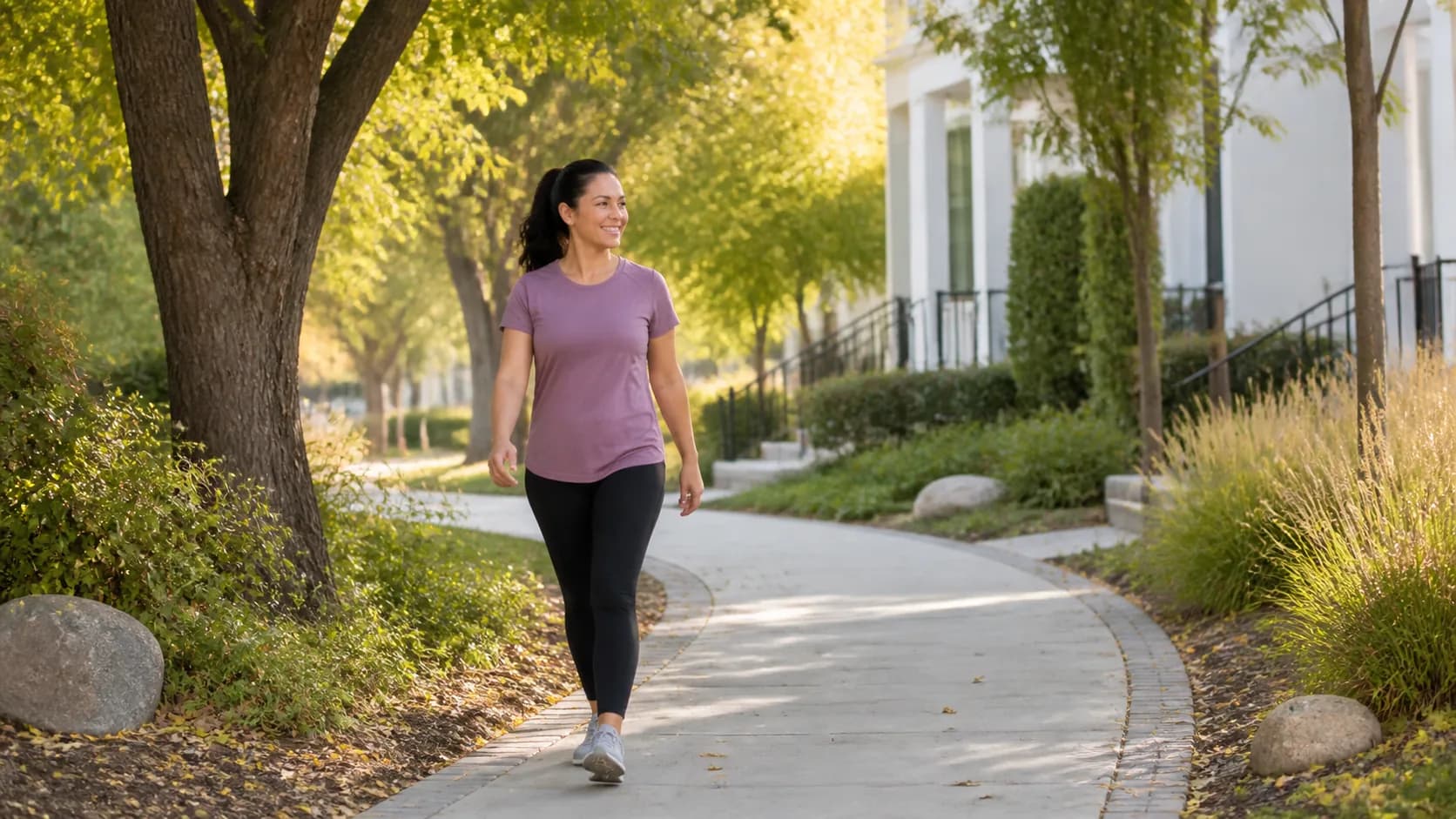
For many people, walking 5,000 steps takes around 42 to 63 minutes of moving time. That range assumes roughly 80 to 120 steps per minute. Your total time may be shorter or longer because cadence, route, stops, mobility, and how your device counts all vary.
There is no “correct” time to reach 5,000 steps. The useful target is a pace and schedule you can repeat comfortably. Here is how to turn a generic range into a realistic plan.
Estimated moving time for 5,000 steps
To estimate time, divide the step goal by your average steps per minute:
minutes = 5,000 ÷ your average steps per minute
| Average walking rhythm | Calculation | Estimated moving time |
|---|---|---|
| Comfortable: 80 steps/min | 5,000 ÷ 80 | about 63 minutes |
| Purposeful: 100 steps/min | 5,000 ÷ 100 | about 50 minutes |
| Brisk: 120 steps/min | 5,000 ÷ 120 | about 42 minutes |
Those numbers describe moving time, not necessarily the time between leaving home and returning. Add time for crossings, a dog, a hill, water breaks, waiting for someone, or a stop at a store. A route can be a great part of your day even when its elapsed time is much longer.
The personal calibration method
Rather than choosing the row that sounds right, measure a short sample. It takes less time than guessing and works with the device you actually use.
- Start a ten-minute walk at your usual pace.
- Bring or wear the same phone or wearable you normally use.
- Record the steps at the end.
- Divide by ten for steps per minute.
- Divide 5,000 by that number.
Say you take 920 steps in ten minutes. That is 92 steps per minute. At the same rhythm, 5,000 steps would take about 54 minutes of moving time. Try it on another day or terrain type if you need a dependable range.
This approach is more useful than a conversion based on someone else’s stride. A tall person and a shorter person can cover the same distance with different totals; a person using a mobility aid may have another safe and effective cadence entirely.
Is 5,000 steps a good daily goal?
It can be a meaningful goal for some people, but it is not a universal prescription. The current activity guidelines focus on total activity and intensity rather than one mandatory daily step count. If 5,000 is above your current average, work up to it. If it is below your usual total, it can still be an intentional easy-day floor rather than a ceiling.
Look at a baseline week first. Then choose one of these approaches:
| Your starting point | A reasonable first move |
|---|---|
| Under 3,000 steps most days | Add one five- or ten-minute walk, then reassess. |
| Around 3,500–4,500 steps | Add 500 steps or a short routine walk on several days. |
| Near 5,000 steps already | Make the goal consistent before increasing it. |
| Well above 5,000 steps | Use 5,000 as a recovery-day baseline or set another purpose-based goal. |
The daily step-goal tool is designed for this kind of gradual target-setting. A goal should create a useful cue to move, not a reason to force extra steps late at night.
You can split the walking up
You do not have to walk for 50 minutes at once. Splitting the total may suit work, heat, childcare, fatigue, and attention better.
At an average 100 steps per minute, a 5,000-step day might look like:
- 15 minutes after breakfast: roughly 1,500 steps
- 20 minutes at lunch: roughly 2,000 steps
- 15 minutes after dinner: roughly 1,500 steps
It will not always add up exactly. Your incidental steps, pauses, and pace will change each segment. The point is to make movement fit life, not to create three new deadlines.
If you are returning after an illness, injury, or a long inactive period, make the first goal smaller. Repeated pain, new swelling, breathlessness out of proportion to effort, dizziness, or chest symptoms should not be pushed through for the sake of a counter.
Let the number tell a story, not run the day
Step count is good at revealing patterns: perhaps a commute adds 1,200 steps, a walking meeting adds 800, or a favorite loop takes 23 minutes. It is not a complete measure of health, strength, sleep, stress, or recovery. Two 5,000-step days can feel completely different.
Build 5,000 steps into the day you actually have
The time estimate is most useful when it helps you find realistic windows. If an uninterrupted hour is unlikely, arrange the total around transitions you already have: a short loop after breakfast, an errand on foot, a break between meetings, or a relaxed stroll after dinner. These are examples, not obligations. Someone with an active job may already reach 5,000 before a planned walk; someone with limited mobility may choose a different personal target or activity measure.
| Common barrier | Flexible response |
|---|---|
| No 50-minute block | Split movement into short sessions across the day. |
| Bad weather or poor air quality | Use an indoor route or move on another day if appropriate. |
| Low energy | Choose the shorter version rather than abandoning the whole routine. |
| Phone is often left behind | Use a consistent wearable or treat the step total as incomplete data. |
| Active shift already produces many steps | Pay attention to recovery instead of adding a catch-up walk. |
Separate moving time from total daily steps
Five thousand steps may come from one deliberate route, everyday errands, a commute, work, or a mix. That is why the estimated 42–63 minutes is a calculation for continuous walking, not a prediction of how much free time every 5,000-step day needs. A person may reach the total with very little planned walking; another may need a full route. Both can use the metric without comparing their days.
If your goal is aerobic fitness, consider effort as well as the step total. A comfortable pace may be the right choice for habit-building or recovery. A brisker pace may add challenge once you tolerate the time on your feet. The talk test offers a simple guide: moderate activity generally raises breathing while allowing conversation, but it is not a clinical assessment or a target everyone should chase.
Check comfort before adding more
When 5,000 steps becomes ordinary, you do not have to increase it. It can be a useful maintenance marker, a recovery-day floor, or simply a record of a normal active day. Increase only when you have a reason and when your feet, joints, energy, and schedule are responding well. Change one variable at a time—duration, pace, surface, hills, or frequency—so you can tell what is causing a benefit or problem.
Persistent pain, swelling, altered gait, dizziness, chest symptoms, or breathlessness that is unusual for you are reasons to stop and seek appropriate guidance. A tracker cannot decide whether a body signal is safe to ignore, so those observations come before any target.
Make the goal flexible over time
Your normal day can change after a move, new job, travel, illness, a change in commuting, or a new device. Recheck the baseline rather than insisting on an old goal that no longer fits. A low total may reflect a quieter day, a recovered rest day, or an activity that does not record steps—not a failure to be active.
It is also fine to use a range instead of one threshold. For example, a workday range gives room for meetings and weather while preserving a useful cue to get up and move. Ranges reduce the temptation to pace late at night for a few remaining steps.
Stepsly is an iPhone app that uses Apple Health data to show your steps, goals, history, and widgets. It can help you identify what 5,000 steps looks like in your week and make small changes visible. It cannot guarantee calorie burn, choose a safe pace, or replace clinical care. View Stepsly on the App Store (opens in a new tab).
Continue with how many steps a 20-minute walk may include, a guide to 45 minutes of walking, and whether 7,000 steps can be enough. For route planning, try the walking pace calculator.
Sources, notes & disclaimers
-
Planning doses use the Physical Activity Guidelines for Americans (opens in a new tab): 150–300 moderate weekly minutes plus strength work on 2 days for most adults who can safely do so.
-
Physical Activity Guidelines for Americans, 2nd edition (opens in a new tab) recommends adults move more and sit less; its activity target is time- and intensity-based, not a universal daily-step mandate.
-
Walking cadence and moderate intensity: systematic review (opens in a new tab) describes 100 steps per minute as a useful general cadence heuristic for many adults, not an individual target.
-
Step-counting measurement review (opens in a new tab) discusses device and measurement considerations that can affect recorded steps.
-
This guide is general education. Check with a qualified clinician before a major change in activity if you have health conditions, pain, recent surgery, pregnancy-specific concerns, or symptoms that make walking unsafe.