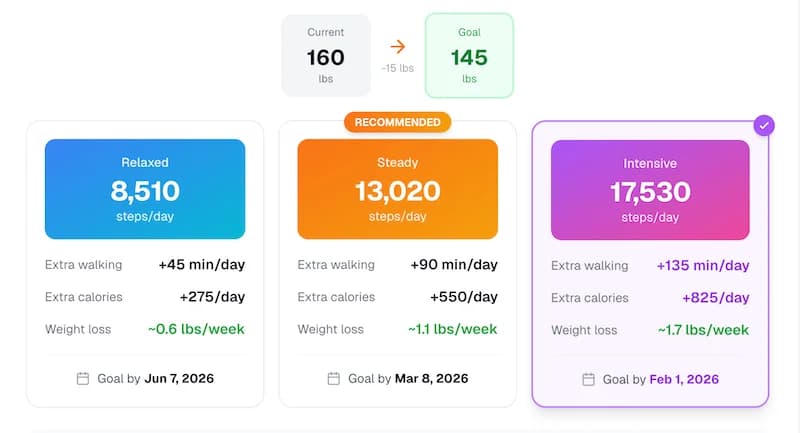
There is no exact number of steps that causes one pound of weight loss. The internet often tries to convert steps to calories and calories to pounds, but every part of that chain is an estimate. Your step length, walking speed, hills, body size, food intake, resting metabolism, medication, sleep, and day-to-day activity all change the result.
The better use of steps is as a behavior target: a measurable way to add walking to a routine. Let body-weight change be evaluated over time with the context it needs, rather than expecting a device to turn one exact step total into a promised outcome.
Why the calculation breaks down
The simplified “calories per pound” rule treats the body like a fixed accounting system. In reality, weight change affects energy needs, and the composition of weight lost can vary. NIH researchers developed dynamic models because static predictions can substantially overestimate long-term weight loss.
Step counts introduce another layer of uncertainty. Two people can take the same number of steps at different speeds, on different terrain, with different walking mechanics. A phone may be left on a desk; a wrist device may count slightly differently from a hip device. Even a precise step count would not provide a precise energy deficit.
What a step goal can do well
Steps are excellent for turning “move more” into a visible action. A personal baseline can reveal that a ten-minute lunch walk adds a reliable amount of movement, or that weekends carry most of your activity. That information can help you create a routine without needing to know how many steps equal a pound.
Try this approach:
- Track a normal week using one device.
- Choose a small addition, such as 500–1,000 steps or five to ten walking minutes.
- Repeat it for one or two weeks.
- Notice comfort, time, energy, and whether the habit is realistic.
- Increase only when the current level feels stable.
This progression is more likely to protect joints and motivation than a huge daily target chosen from a calorie calculation.
Weight loss is a systems question
The CDC and NIDDK describe weight management as a combination of eating patterns, activity, sleep, stress management, and individual factors. A person may increase steps and see no immediate scale change because of fluid shifts, increased food intake, changes in strength training, or normal variability. That does not mean the walking has no value.
If weight change is a specific goal, use a trend over weeks and combine the walking plan with an eating pattern you can sustain. The NIH Body Weight Planner can help adults explore personalized scenarios, but it should not replace care from a clinician or registered dietitian where that is needed.
| Common thought | A more useful interpretation |
|---|---|
| “I hit my steps; I should have lost weight.” | One behavior does not control every factor that influences body weight. |
| “My tracker says I burned enough.” | The value is an estimate, not a food allowance or prediction. |
| “I missed my target; I need to double it tomorrow.” | Resume the routine; abrupt catch-up sessions increase load without fixing the system. |
| “The scale stalled, so walking failed.” | Look at longer trends and non-scale markers; adjust with qualified support if needed. |
Use estimates without letting them drive the plan
The walking calorie calculator can show how different pace, distance, and body weight affect an estimate. Treat the output as an educational range. It is not a prescription for how much to eat or how many steps you must take.
If tracking becomes compulsive, creates guilt around food, or triggers binge/restrict behavior, step back and seek support. A health plan should make life more workable, not turn every meal and walk into debt accounting.
Use steps to build a routine, not settle a calculation
A step goal is most useful when it answers a behavioral question: when will I walk, and how will I know I did it? Start by observing a normal week using one device. Notice which days are naturally active, which are mostly seated, and what time a short walk could actually happen. A baseline gives you a more reliable next move than any online claim about steps per pound.
Then choose a small addition. For one person, that may be 500 extra steps on three days. For another, it may be five minutes after lunch or an indoor loop during a work break. Keep the change easy enough that it does not require a late-night catch-up session. Once it is ordinary, increase one element only.
| Tracking result | Better response |
|---|---|
| Your total is lower than planned | Resume the routine at the next opportunity; do not punish yourself with an abrupt increase. |
| You meet the total but feel sore or exhausted | Keep the count steady or reduce it while you assess recovery. |
| Steps rise but body weight is unchanged | Continue evaluating the wider routine and longer-term trend. |
| You dislike the target | Change the cue, route, duration, or metric so movement remains sustainable. |
Understand what the tracker cannot see
The same total can represent a relaxed day of errands, a demanding job shift, a brisk hill walk, or a series of short indoor breaks. It cannot show pace, terrain, load carried, sleep, eating, pain, or whether the phone was actually with you. It also misses many valuable activities, including cycling, swimming, resistance training, and adapted exercise. Do not let the visibility of steps make other movement disappear from your plan.
If weight management is the goal, keep a broad record: walking minutes, strength sessions, meal regularity if it is safe to track, sleep, stress, and any clinician-recommended measures. This makes it easier to see what is changing without claiming that a device has found a precise cause-and-effect relationship.
Protect yourself from false precision
It is tempting to take a calorie estimate, divide by a standard number, and create a “steps per pound” target. That calculation is attractive because it looks certain. But it cannot account for changes in appetite, other activity, body composition, medication, health, or the way energy needs adapt over time. A narrow number can also invite compulsive checking and escalating daily demands.
Use the calculator, if you use it at all, to compare the relative effort of your own routes—not to decide how much food you deserve or how quickly your body must change. A slower, steadier plan that preserves sleep and comfort is more likely to support wellbeing than an exact-looking target you cannot live with.
Know when a different measure is better
For some people, tracking steps is motivating. For others, it is anxiety-provoking or inaccessible. Consider tracking time outdoors, minutes of movement, a route completed, strength sessions, or a personal feeling-of-effort scale instead. Those measures can be especially helpful for people whose primary activities do not translate neatly into steps.
If a scale or step target is bringing guilt, secrecy, rigid food rules, or pressure to exercise through pain, pause and get qualified support. The right plan should improve health and daily function, not make ordinary eating and movement feel like a ledger.
A calmer way to set the next target
Set a target that reflects the next action, not the body change you expect. “Walk for ten minutes after lunch on Monday, Wednesday, and Friday” is more actionable than “take enough steps to lose a pound.” Put the walks in the part of the day where they are least likely to compete with sleep, meals, or safety. Review the plan after a week, then keep, simplify, or gradually extend it based on how it actually felt.
That process makes the number serve you. It also leaves room for ordinary rest, illness, travel, and life events without turning them into reasons to abandon movement altogether.
Stepsly (opens in a new tab) is an iPhone app that uses Apple Health data to show steps, goals, history, and widgets. It can help record your walking trend. It cannot calculate an exact calorie deficit, diagnose weight change, or prescribe a nutrition plan.
Read how many miles to walk to lose weight, how long to walk to lose 10 pounds, and is 7,000 steps enough? for related planning.
Sources, notes & disclaimers
-
Planning doses use the Physical Activity Guidelines for Americans (opens in a new tab): 150–300 moderate weekly minutes plus strength work on 2 days for most adults who can safely do so.
-
NIDDK Body Weight Planner (opens in a new tab) uses a dynamic model for adult planning and makes clear its scope and limitations.
-
NIH technology summary: dynamic weight-loss modeling (opens in a new tab) explains why the traditional fixed calorie-per-pound rule is limited.
-
CDC: steps for losing weight (opens in a new tab) describes gradual, multifactorial weight management.
-
This article is general education, not medical or nutrition advice. Seek individual help for medical conditions, medication questions, pregnancy, pain, or disordered-eating concerns.