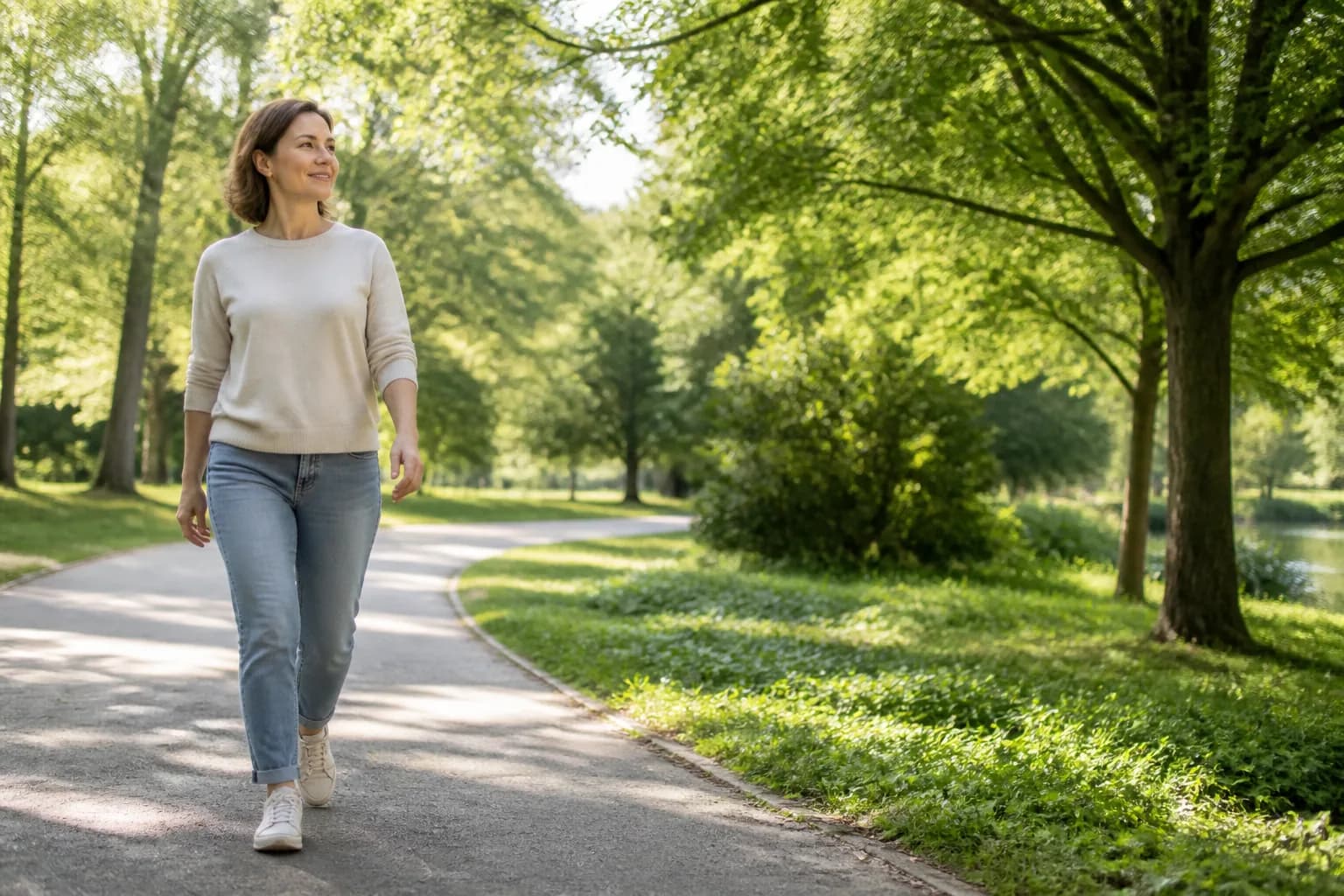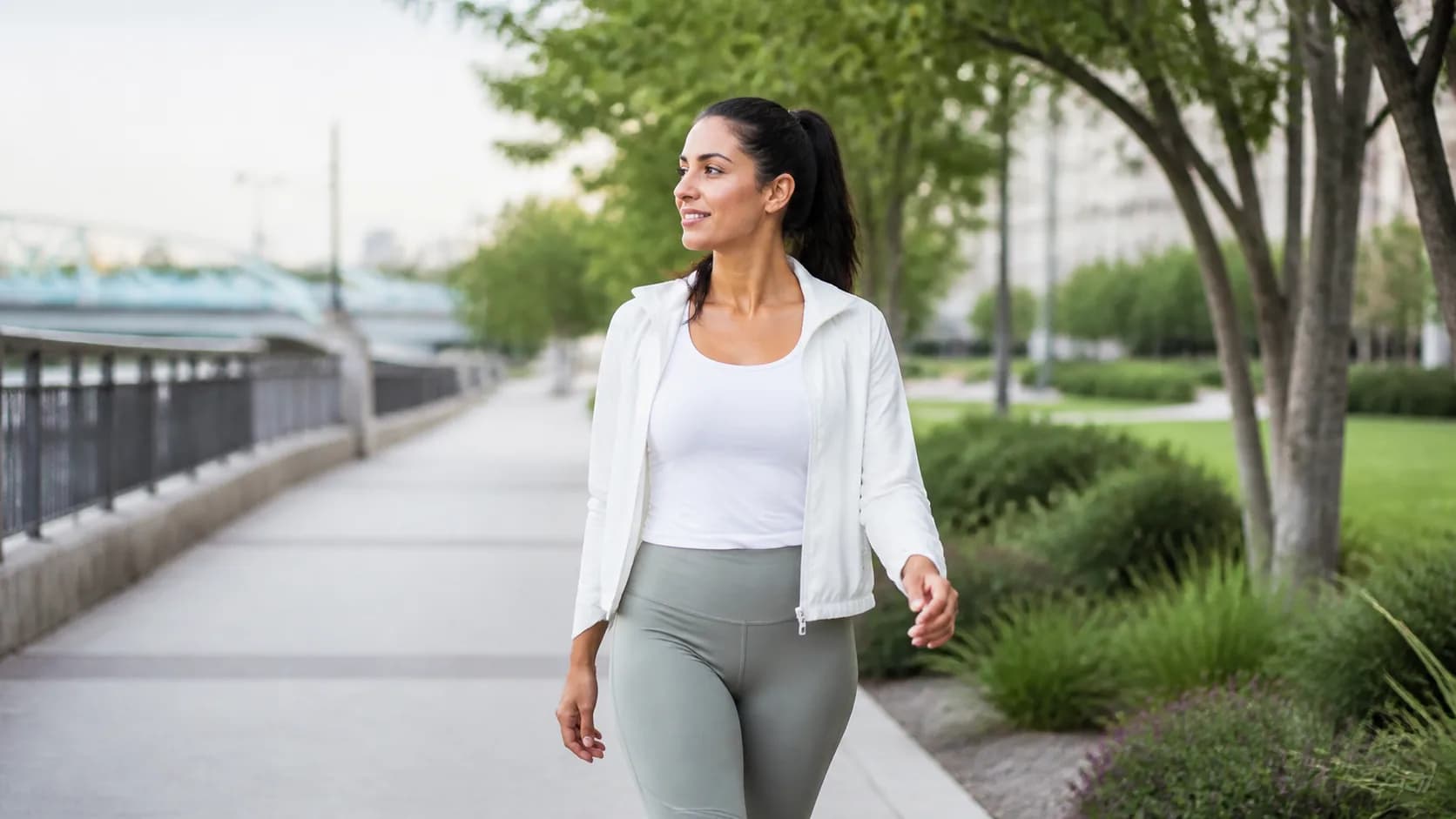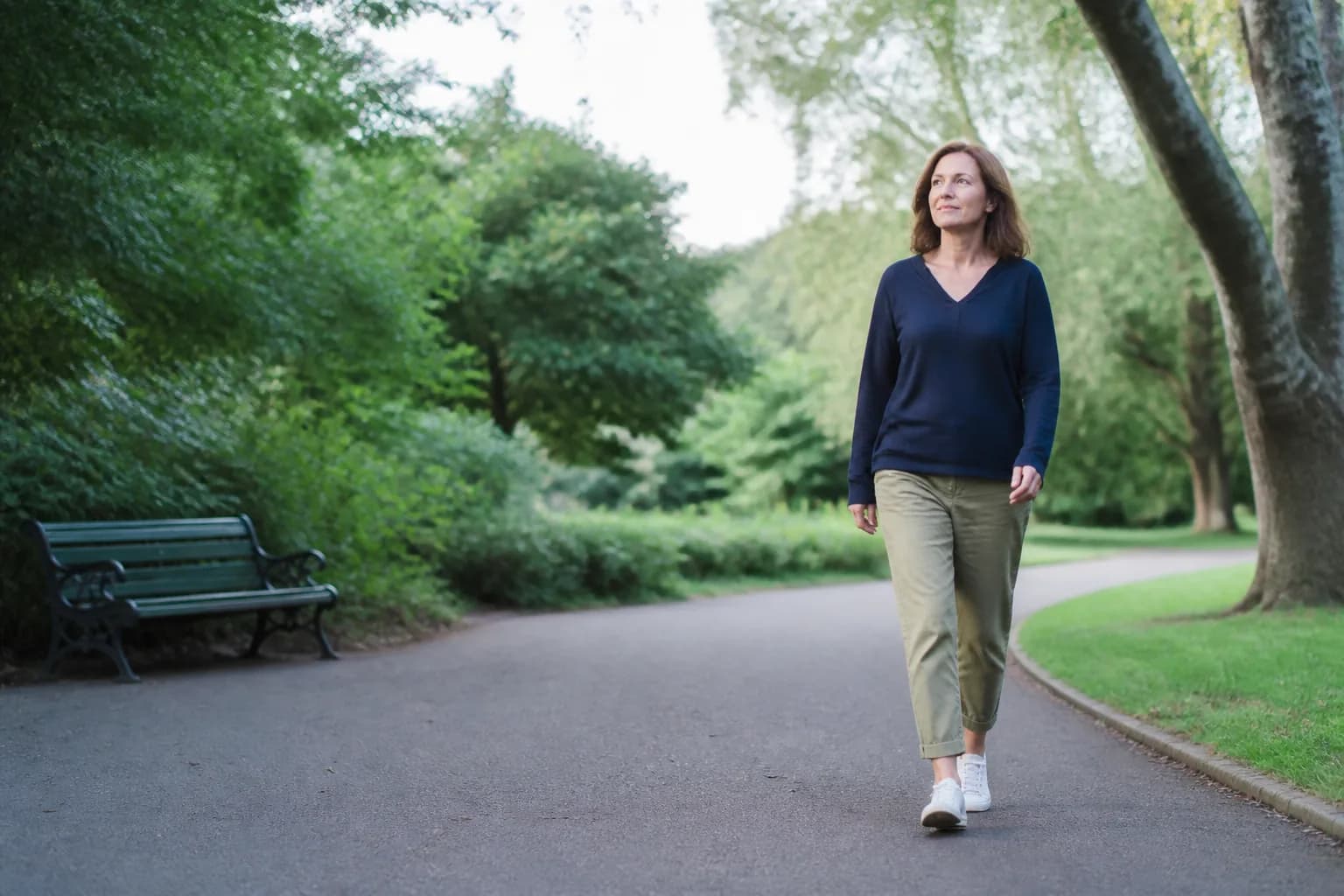
Walking can be a very practical form of movement during perimenopause and menopause: it is easy to scale, needs little equipment, and can fit around a fluctuating day. The useful goal is not to force the same pace or step count every day. It is to build a routine that you can repeat while still making room for sleep disruption, heat, joint comfort, work, and strength training.
The simplest starting point is a comfortable walk you could repeat tomorrow. From there, add time, a small amount of pace variation, or another walking day—one change at a time. A walk still counts when it is easy, short, indoors, or split into small pieces.
What walking can do—and what it cannot promise
Walking is weight-bearing aerobic activity. It can contribute to the weekly activity that supports cardiovascular health and everyday fitness, and it is a useful way to spend more time moving. A brisk walk may feel more demanding than it used to on some days; that is a reason to adjust the dose, not proof that walking has stopped being worthwhile.
It is important not to oversell it. Walking is not a guaranteed treatment for hot flashes, sleep problems, mood changes, body-composition changes, or bone loss. Those experiences have many possible causes and deserve individualized medical care when they are troublesome. Movement can be one useful part of a broader plan that might also include sleep habits, nutrition, prescribed treatment, and strength or balance work.
The broad adult guideline of 150 minutes of moderate-intensity activity per week is a reference point, not a pass/fail test. A person beginning from little activity may start with five or ten minutes. Someone already walking regularly may prefer a longer easy walk, a hill once a week, or a few brisk sections. The best dose is one that fits your symptoms, recovery, and preferences.
Let the day set the version of the walk
Rather than labeling a day “good” or “bad,” choose one of three walking modes. This makes a plan resilient when sleep, temperature, or energy changes.
| How the day feels | A sensible walk | What success looks like |
|---|---|---|
| Low energy, poor sleep, or unusually warm | 5–15 easy minutes in a cool, familiar place; or two short indoor walks | You finish feeling no worse than when you started. |
| Typical day | 20–40 minutes at a conversational pace | You are breathing more deeply but can still speak in sentences. |
| Plenty of energy and no concerning symptoms | Add 3–6 brief brisk sections, a gentle hill, or a longer route | You recover comfortably by the next day. |
The talk test is often more practical than chasing a fixed speed. Easy movement permits comfortable conversation. Moderate effort makes talking possible but singing difficult. If a new pace feels breathless, painful, or unsteady, it is too hard for that day regardless of what a watch or treadmill number says.
Make heat and comfort part of the route plan
If heat sensations or sweating interrupt a walk, use logistics rather than willpower. Walk earlier or later, choose shade or an indoor route, carry water when appropriate, and wear breathable layers you can remove. A loop close to home can be more useful than a long point-to-point route if you want the option to shorten it.
Comfort also includes feet and joints. Shoes do not need to be expensive, but they should feel stable and leave room at the toes. A route with a predictable surface is often easier to gauge than uneven trails when you are learning how your body responds. If dizziness, faintness, chest discomfort, new severe shortness of breath, or a sudden severe headache occurs, stop and seek urgent medical advice rather than trying to “walk through” it.
Pair walking with strength and balance
Walking challenges the heart, lungs, and lower body, but it is not a full strength program. Resistance exercise and balance practice add things that walking alone may not: targeted loading for muscles, pulling and pushing movements for the upper body, and practice controlling position. The exact program depends on your history, access, and clinical advice, but a simple weekly pattern is often more sustainable than a heroic daily target.
One example:
- Walk on three to five days, mixing easy and moderately brisk sessions.
- Do two nonconsecutive strength sessions using body weight, bands, or weights that you can control with good form.
- Add brief balance practice near a stable support, if it is safe for you.
- Keep at least one day deliberately lighter when fatigue or soreness accumulates.
If you are new to strength work, have osteoporosis, pelvic-floor symptoms, a prior fracture, significant joint pain, or other medical concerns, ask a clinician or qualified physical therapist for advice that fits you. That is more useful than copying a generic social-media workout.
A four-week walking reset
This is a starting template, not a prescription. Keep the previous week’s amount if it feels like enough; do not increase simply because the calendar says to.
Week 1: establish the cue
Choose three days and walk for 10–15 minutes at an easy pace. Attach the walk to something already in your day: after lunch, after a school drop-off, or while listening to a favorite podcast. Note only two things afterward: how long you walked and how you felt later that day.
Week 2: add frequency or a few minutes
Add a fourth easy walk, or add five minutes to two of the existing walks. Do not add both if the first week left you unusually tired. Try the daily step-goal tool as a way to set an increase from your own baseline rather than copying someone else’s target.
Week 3: experiment with pace
During one familiar route, include four 30- to 60-second periods that are a little quicker. Recover at an easy pace between them. You should finish with the sense that you could have done one more repetition. If that is not true, make the next session easy.
Week 4: choose the version you want to keep
Review which walks fit best: a daily ten minutes, a 30-minute weekend route, a social walk, or short indoor breaks. Keep the pattern that survives a busy week. Consistency is more valuable than a plan that only works in ideal conditions.
Track patterns, not perfection
A step count can reveal patterns—whether a desk-heavy day is truly low movement, whether a lunch walk is happening, or whether weekend activity is carrying the whole week. It should not become a scorecard. Use a tracker to notice the relationship between routines and activity, then choose a small next action.
Stepsly (opens in a new tab) is an iPhone step counter that uses Apple Health data to show daily activity, goals, streaks, history, and widgets. It can be useful if a visible daily total or a gentle goal helps you remember a walk. It is not a medical device and does not replace individualized menopause care.
For more ways to make a routine fit real life, see walking after 50, walking 45 minutes a day, and our walking pace calculator.
A few useful ways to remove friction
The most effective route may be the least glamorous one. Keep a light layer and walking shoes where you can see them, map a shaded ten-minute loop, and decide in advance what counts on a difficult day. For some people, that is five indoor minutes after breakfast; for others, it is a short evening walk with a friend. It is also reasonable to stop a walk early because the environment is too hot, the surface feels unsafe, or your body is asking for recovery. A plan that has an easier version is a plan you are more likely to return to.
Try a brief weekly review instead of daily judgment. Ask: Which day did the walk feel easiest to begin? Did a certain time of day make heat or fatigue more manageable? Is there a pattern between a larger activity increase and poorer recovery? Use those observations to change the next week by one small thing. That turns tracking into a feedback loop rather than another obligation.
When to get individualized advice
Seek medical guidance before changing activity substantially if you have a new diagnosis, unexplained symptoms, a history of cardiac or breathing problems, or a clinician has given you activity restrictions. Speak with a menopause clinician about symptoms that are disrupting sleep, work, or quality of life; a walking plan should support care, not delay it.
Sources, notes & disclaimers
-
Planning doses use the Physical Activity Guidelines for Americans (opens in a new tab): 150–300 moderate weekly minutes plus strength work on 2 days for most adults who can safely do so.
-
U.S. Physical Activity Guidelines (opens in a new tab) describe activity recommendations for adults. They are population guidelines, not individualized exercise prescriptions.
-
The Menopause Society: hot flashes (opens in a new tab) discusses menopause symptoms and the role of regular exercise in overall health.
-
Australasian Menopause Society: lifestyle advice for healthy ageing (opens in a new tab) discusses physical activity, including weight-bearing and strength activity, in midlife and beyond.
-
This article is general education, not medical advice. Stop activity and seek urgent help for concerning acute symptoms. Discuss symptom changes, pregnancy possibility, medications, fractures, osteoporosis, or a new exercise plan with a qualified clinician when relevant.