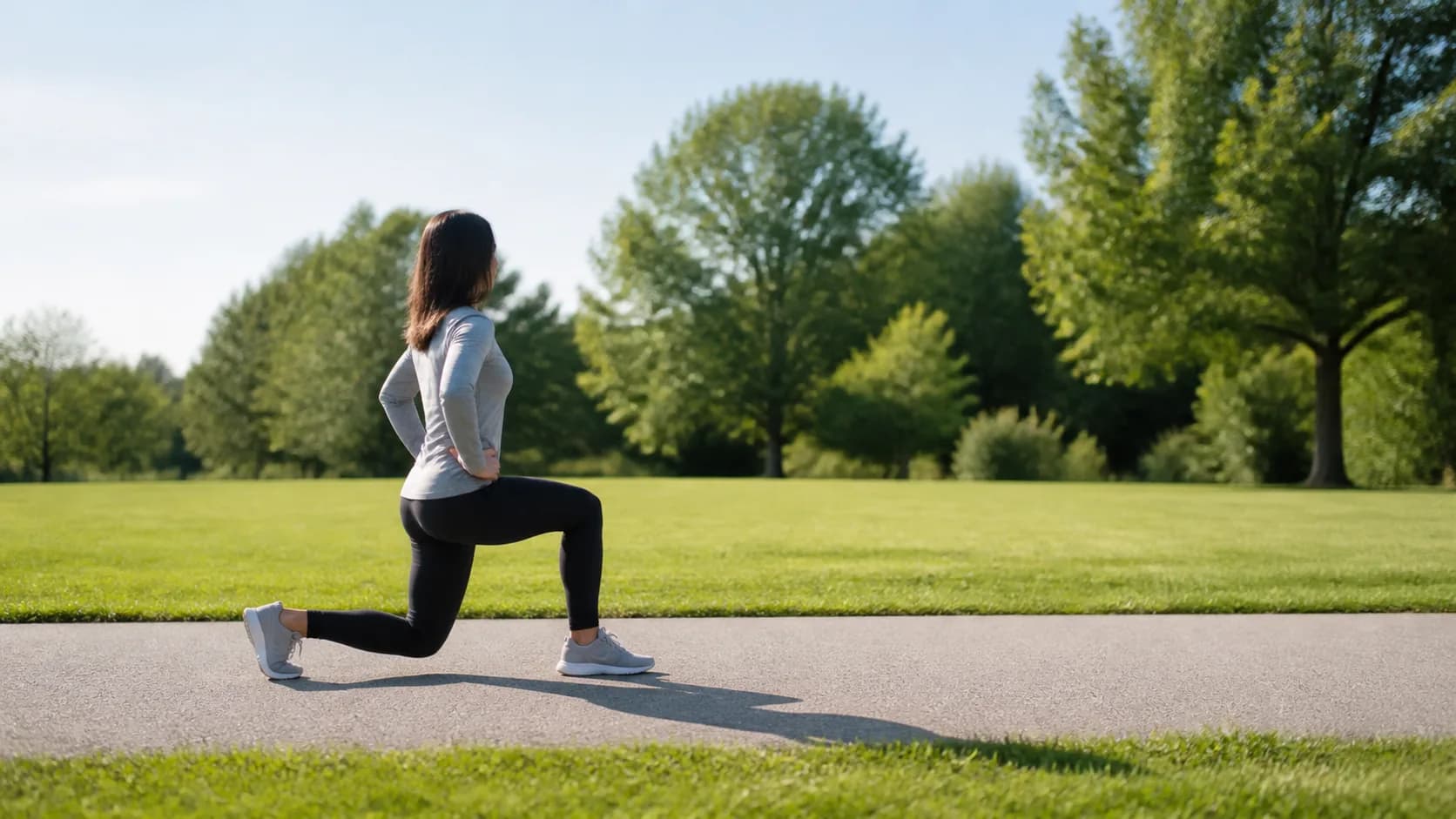
Walking uses your calves, quads, hamstrings, glutes, and trunk muscles to move and stabilize you. For people who are inactive, returning after time away, or older, regular walking may improve functional strength and walking tolerance. It is not usually enough stimulus to build large amounts of muscle in a trained person.
What walking can do
| Goal | What walking contributes |
|---|---|
| Daily function | Supports endurance for standing, stairs, and errands. |
| Lower-body activity | Repeatedly uses the legs and hips. |
| Beginner progress | Can improve capacity when starting from a low baseline. |
| Muscle size | Usually limited without progressive resistance. |
Hills, stairs, and a brisker pace can make the legs work harder, but they are still not equivalent to a well-designed strength routine.
Add strength without abandoning walking
Twice a week, consider simple movements such as sit-to-stands, supported squats, step-ups, rows, pushes, and carrying light objects. Begin with a range and resistance you can control. The goal is progressive strength, not soreness.
Walking can remain the foundation: it gets you moving regularly, supports aerobic fitness, and makes activity easier to maintain. Strength work fills a different need.
Stepsly can show walking consistency, goals, and long-term progress. It does not measure muscle mass or replace a strength program.
For a practical routine, read walking for bone and joint health, stair climbing benefits, and walking lunges.
Muscle endurance and muscle size are different
Walking repeatedly uses lower-body and trunk muscles, so it can improve comfort with standing, hills, stairs, and longer outings. Those functional changes are real and worthwhile. They do not necessarily mean a large increase in muscle size. Muscle hypertrophy generally requires a progressive resistance stimulus that becomes challenging as the body adapts, alongside adequate recovery and nutrition.
| Outcome | What walking may contribute | What usually needs more than walking |
|---|---|---|
| Daily leg endurance | Repeated comfortable use of legs and hips. | — |
| Better tolerance for stairs/errands | More time on feet and movement practice. | — |
| Initial strength gain after inactivity | Some improvement from a new activity stimulus. | Continued progression after the beginner phase. |
| Noticeable muscle size | Limited for most trained people. | Progressive resistance training. |
| Body-composition change | Part of total activity and routine. | No guarantee from walking alone. |
This distinction prevents two unhelpful extremes: dismissing walking because it is not bodybuilding, or claiming it will build the same muscle as a strength program.
Make walking a foundation, not a substitute
Walking can be the reliable activity that makes strength training easier to sustain. It can warm you up before a session, support active recovery, and provide low-barrier movement on non-lifting days. If you want muscle development, add a small progressive strength routine that matches your current ability.
Begin with movements you can control: sit-to-stands from a stable chair, supported squats, step-ups on a safe low step, calf raises near support, rows with an appropriate resistance, and pushes against a wall or countertop. Two sessions a week can be enough to begin. Start with a modest number of repetitions and stop with good form still available; adding soreness is not the purpose.
| Beginner need | Possible lower-body option |
|---|---|
| Learn standing strength | Sit-to-stand from a chair. |
| Build calf tolerance | Supported calf raises. |
| Practice step control | Low step-ups with a rail or wall nearby. |
| Train hip/knee control | Supported squat or split-stance hold. |
| Prefer no equipment | Bodyweight movements with an appropriate range. |
Hills and stairs: useful but not magic
Hills, stairs, faster walking, and longer routes can make a walk more demanding. They may be useful variety for someone who already tolerates flat walking. But they still do not create a predictable muscle-building program, and they can add stress to calves, knees, feet, Achilles tendons, and balance systems. Increase one variable at a time and use flat easy walks between new hill or stair sessions.
Do not add a weighted vest or loaded pack solely to force muscle growth. External load changes the risk profile. A controlled strength session is often the clearer and safer way to add resistance.
How to judge progress honestly
Look for functional outcomes: a familiar walk feels easier, you can stand from a chair more comfortably, you recover from stairs better, or you can perform a controlled strength movement with a little more range. These improvements matter even when the mirror, scale, or step count does not change on schedule.
Stepsly can show whether your walking is becoming consistent through Apple Health steps, goals, history, and widgets. It cannot measure muscle mass or tell you that a particular walk created a hypertrophy stimulus. Pair its data with simple strength notes if building muscle is an explicit goal.
Keep expectations and safety aligned
Muscle gain, body composition, and strength all vary with training history, food intake, sleep, age, hormones, medical conditions, and recovery. Avoid an exercise plan that turns food into something to earn or that demands a visible change from one body part. Seek qualified support for persistent pain, a new weakness, a recent procedure, or a condition that affects safe strength exercise.
A simple two-day strength add-on
You do not need to replace walking with a complicated gym schedule. Pick two non-consecutive days and choose two or three movements that cover the legs, pushing, pulling, and trunk control at a manageable level. For example: sit-to-stands, supported calf raises, wall pushes, and a row with an appropriate band. Start with one or two sets and leave several repetitions “in reserve” rather than working until form breaks down.
| Week | Strength focus | Walking focus |
|---|---|---|
| 1–2 | Learn controlled movement and comfortable range. | Keep normal easy walks. |
| 3–4 | Repeat the same dose, perhaps adding a few repetitions. | Add brisk or hill variation only if recovered. |
| 5+ | Increase resistance or range gradually. | Use walking for regular aerobic time and recovery. |
The progression can be tiny: an extra sit-to-stand, a slightly lower chair only when safe, or a small resistance change. It is the repeated challenge, not a dramatic workout, that creates a strength-training signal.
How food and recovery fit without becoming a diet rule
Muscle tissue needs energy and protein, but an article cannot calculate an individual’s needs from a step total. Eat regular meals that suit your preferences, medical needs, and activity level. If you are intentionally trying to gain muscle, manage body weight, or have a health condition that changes nutrition needs, a registered dietitian can help create a plan that does not rely on generic online rules.
Sleep and rest matter as well. A person who walks, strength trains, sleeps poorly, and is constantly sore may need a smaller plan rather than more motivation. Deloading or maintaining a comfortable routine is part of progress.
Common misunderstandings
“My legs are tired, so I built muscle.” Tiredness means you used them; it does not measure muscle growth.
“Hills are strength training.” They can add leg demand but do not replace progressive resistance for most muscle-building goals.
“I should add weight to every walk.” Loaded walking is optional and carries separate joint/balance demands. A controlled strength session is usually clearer.
“No visible change means walking failed.” Improvements in endurance, mood, routine, and daily function are valuable outcomes even when appearance is unchanged.
Use walking as an honest baseline
Walking data can still be helpful when strength is the goal. It shows whether your daily activity stays steady as you introduce resistance training. If steps drop sharply because a new routine leaves you overly sore, that is a reason to simplify. If normal walks feel easier, that is a functional benefit even if your muscle measurements are unchanged.
Consider recording strength sessions separately from steps: movement selected, sets, repetitions, resistance, and comfort. A tiny training log makes gradual progression visible and helps prevent accidental jumps in load. It also gives a clinician or trainer something concrete to discuss if pain or uncertainty develops.
Choose quality over novelty. A simple program done for months is more likely to support strength than constantly changing exercises in search of a quick visual result.
For additional planning context, see walking and leg tone and walking-lunge benefits.
Sources, notes & disclaimers
-
Planning doses use the Physical Activity Guidelines for Americans (opens in a new tab): 150–300 moderate weekly minutes plus strength work on 2 days for most adults who can safely do so.
-
U.S. guidance recommends both aerobic and muscle-strengthening activity for adults: Physical Activity Guidelines (opens in a new tab).
-
This article is general education. Ask a qualified professional for personalized programming if you have pain, injury, or a condition that affects safe strength exercise.