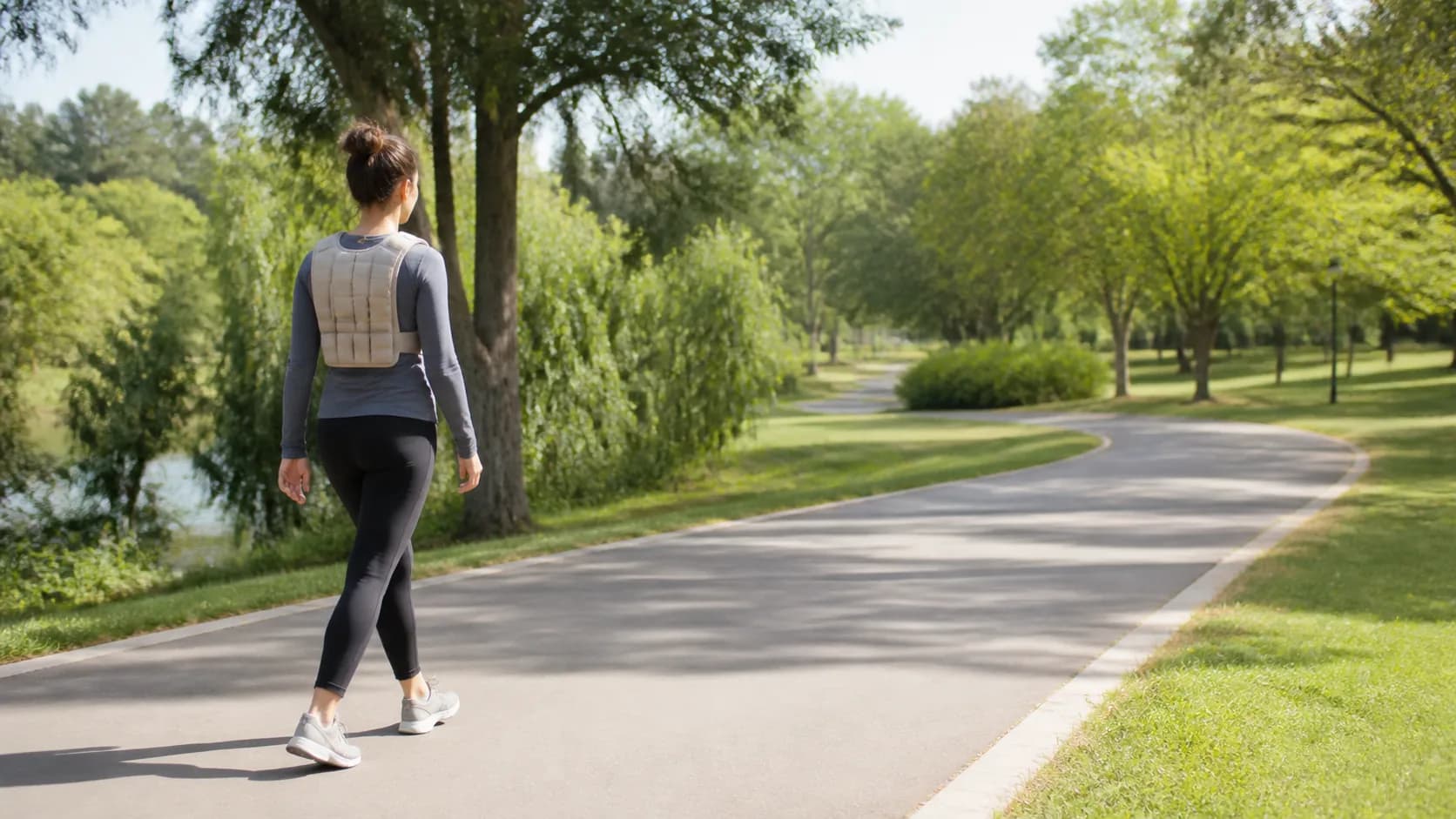


Walking lunges are a strength exercise, not just a more dramatic way to walk. They ask one leg to control the body while the other steps forward, challenging the quads, glutes, calves, and balance.
They can be useful in a strength routine, but they are not required to make walking effective. If your goal is a sustainable daily walking habit, ordinary walking comes first.
What they train
| Area | Role in a lunge |
|---|---|
| Glutes and quads | Help lower and stand back up. |
| Calves and feet | Stabilize the step. |
| Core | Helps keep the torso controlled. |
| Balance | Keeps the movement aligned from step to step. |
Start with a stationary version
Before moving across a room, practice a split-stance lunge near a stable support. Lower only as far as you can control without knee pain, wobbling, or the front heel lifting. A partial range is a valid starting point.
When you can do controlled stationary repetitions, take one slow forward step into a lunge, return to standing, and reset. There is no need to string together many walking lunges immediately.
Form cues
- Keep the front foot fully planted.
- Let the knees track in the same direction as the toes.
- Keep the torso tall rather than collapsing forward.
- Use a shorter step if the hips or back feel pulled.
- Stop before fatigue turns each repetition into a balance drill.
If lunges cause pain, try a sit-to-stand, supported split squat, hill walk, or ordinary brisk walk instead. More complicated is not automatically more effective.
Use fun walking workouts for cardio, walking for bone and joint health, and the Daily Step Goal Calculator to build a routine around movement you can repeat.
Learn the movement in stages
Walking lunges combine a strength movement with forward travel. Breaking the skill into stages keeps the first session from becoming a test of balance.
| Stage | What to practice | Move on when… |
|---|---|---|
| Sit-to-stand | Controlled standing from a stable chair. | Knees and hips feel comfortable in everyday standing. |
| Split stance | One foot forward, one back, with a stable support nearby. | You can hold a balanced stance without wobbling. |
| Partial stationary lunge | Small controlled bend and return. | Both sides feel stable and pain-free. |
| Step-and-reset lunge | One step forward, lower slightly, return to standing. | You can reset posture before each repetition. |
| Walking lunge | Slow linked steps across a clear space. | Technique remains controlled as fatigue rises. |
There is no advantage to skipping stages. A partial stationary lunge can train the same general pattern while giving you more control over depth, support, and alignment.
Set the range of motion to your body
Your front knee does not need to touch a certain angle, and your back knee does not need to reach the floor. Lower only as far as you can keep the front foot planted, knee aligned with the toes, and torso under control. A shorter step can reduce strain for some people; a longer step can feel more stable for others. Experiment gently rather than copying a picture.
If the front knee moves inward, the heel lifts, the trunk collapses forward, or you feel pinching in the hip or back, reduce depth, hold a support, or return to a stationary version. Sharp pain, swelling, instability, or catching are reasons to stop and seek individualized assessment.
A modest beginner strength session
After a five-minute easy walk, try one set of five controlled step-and-reset lunges per side. Rest, then decide whether a second set is appropriate. Finish with ordinary walking. That is enough to introduce the movement; there is no need to make lunges the main event of a walking routine.
| Goal | Easier alternative |
|---|---|
| More leg strength | Sit-to-stands or supported split squats. |
| More daily movement | A brisk forward walk or short hill. |
| Better balance | Supported single-leg weight shifts with professional input if needed. |
| Less boredom | Change routes, add music, or use short walking intervals. |
Keep strength and cardio separate when helpful
Lunges can raise heart rate, but they are primarily a strength-and-control exercise. Counting them as steps or using a step target to decide how many to do can create poor form. Use repetitions, sets, and recovery as the variables. Put walking lunges on a day when your legs are not already exhausted by hills, runs, a long shift, or a heavy lower-body workout.
The adult activity guidelines include muscle-strengthening work on two or more days per week, but they do not require walking lunges. A simple, repeatable strength plan may be safer and more effective for a beginner than adding a complex variation to every walk.
Space, footwear, and recovery
Use a clear, non-slip area with room to take a forward step and return. Avoid rugs that slide, crowded paths, stairs, uneven ground, and carrying weights until bodyweight form is reliable. Stable familiar shoes can help; bare feet may feel fine for some people on a safe surface, but do not use them if balance or foot comfort is uncertain.
Expect some muscle fatigue after a new movement, but do not treat severe soreness as progress. If you struggle with stairs, have pain that lasts more than a couple of days, or notice swelling or altered walking, reduce the dose. A normal forward walk and an easier strength option are valid replacements.
Questions beginners often ask
How many walking lunges should I do? Start with a tiny, controllable amount—perhaps five step-and-reset repetitions per side. Add repetitions only when the previous amount leaves normal walking and next-day comfort unchanged.
Should the knee touch the floor? No. Depth is not a score. Use a range where the front foot stays planted and the knee, hip, and trunk remain controlled.
Can I hold weights? Not until bodyweight movement is steady. Adding external load changes balance and joint demand; it is not the beginner default.
Are walking lunges better than squats? They are different exercises. A supported squat, sit-to-stand, or stationary split squat may be more appropriate depending on your experience, balance, and goals.
Can I do them every day? Most beginners benefit from recovery between new strength sessions. Easy walking can continue, but repeated lunges on sore legs often create poorer form.
Use a stop rule before you begin
Decide in advance that you will stop the set when form changes: the front heel lifts, the knee repeatedly falls inward, you lose balance, or discomfort begins. This makes it easier to end while the movement still looks controlled. The next session can repeat the same dose; repetition is a legitimate progression.
If you have a history of falls, significant knee/hip/back symptoms, joint replacement, recent surgery, pregnancy-specific limitations, or a condition affecting balance or sensation, get tailored guidance. The goal is a lower-body exercise you can perform safely—not loyalty to one variation.
Pair lunges with a simple week
One or two brief lower-body strength sessions can sit beside ordinary walking. For example, on one day walk easily, complete a small controlled lunge or sit-to-stand set, and finish with a cool-down walk. On another day, walk without lower-body strength work. This separation makes it easier to tell whether a new exercise is helping or leaving you too sore.
Use a comfortable route on the following day rather than a hill challenge. If you can walk, use stairs, and sit down normally, the previous dose may have been appropriate. If those activities are clearly worse, repeat less next time. Progress does not require soreness or an ever-larger exercise menu.
Keep the purpose clear
Walking lunges can develop control and leg strength, but they do not have to improve your step total, calorie estimate, or body shape to justify their place. Choose them when you enjoy the movement and it matches a strength goal. Choose another exercise when it does not. This keeps strength training practical instead of making it a performance of difficulty.
Write down the variation, support used, and repetitions after a session. That record lets you repeat a successful dose instead of guessing. It also makes it clear when a small progression has actually been earned by stable form and recovery.
For additional planning context, see whether walking builds muscle and undefined.
Sources, notes & disclaimers
-
Planning doses use the Physical Activity Guidelines for Americans (opens in a new tab): 150–300 moderate weekly minutes plus strength work on 2 days for most adults who can safely do so.
-
The U.S. guidelines recommend muscle-strengthening activity alongside aerobic movement: Physical Activity Guidelines (opens in a new tab).
-
This article is general education, not rehabilitation advice. Seek individualized guidance for pain, instability, recent injury, surgery, or conditions affecting safe lower-body exercise.