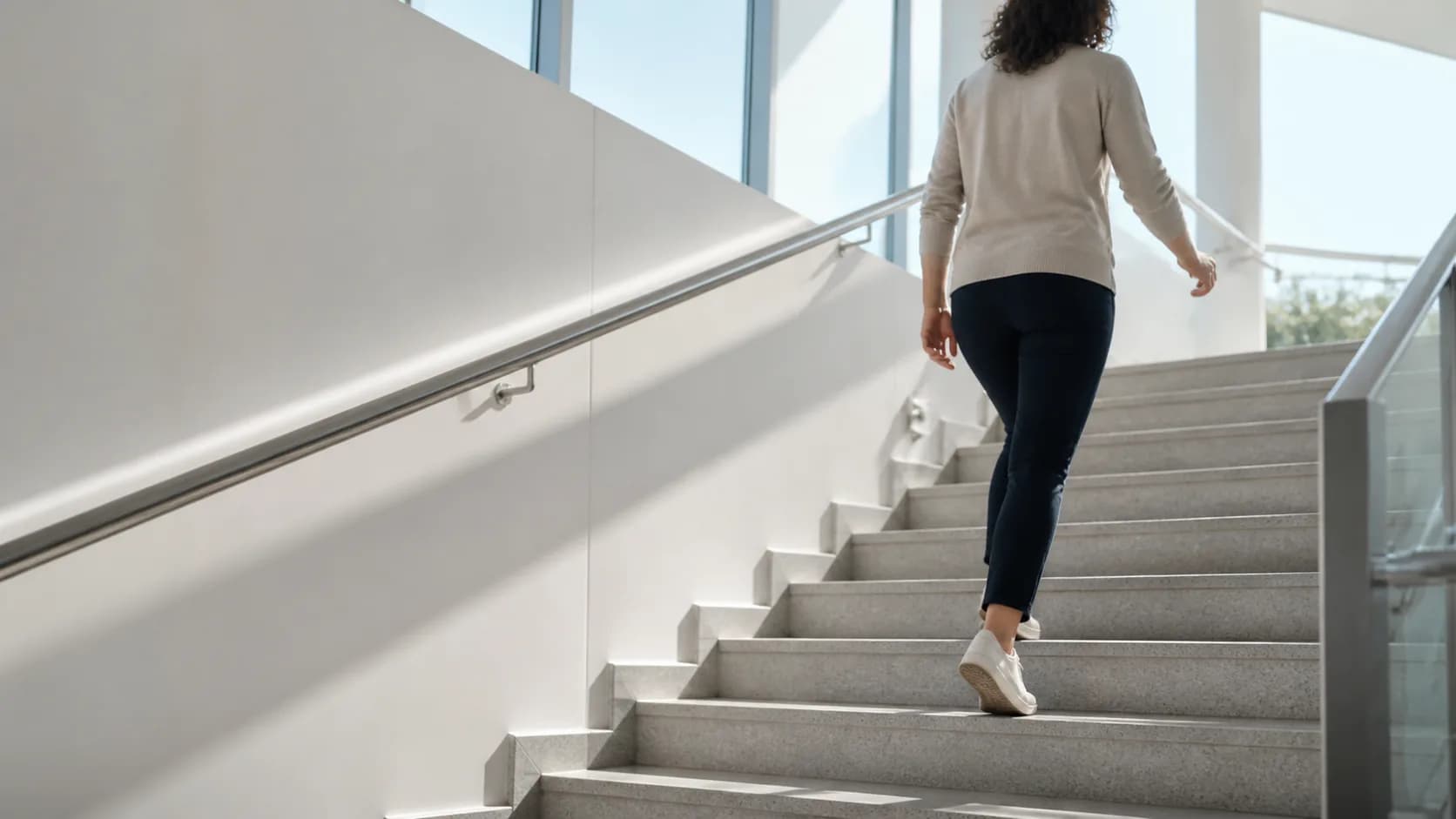
Stair climbing is a convenient way to make everyday movement more demanding. Going up stairs raises effort quickly because you repeatedly lift your body against gravity. That can make short bouts useful, but it can also expose knee, balance, and breathing limitations faster than level walking.
What stairs add to a walking routine
| Change | What it means |
|---|---|
| Higher effort | A short climb can raise breathing rate quickly. |
| More lower-body demand | Glutes, quads, calves, and hips contribute more. |
| Less time needed | It can fit into daily transitions. |
| More balance demands | Handrails and clear steps matter. |
Stairs are not a substitute for all walking, and they do not need to become a punishment. One flight taken comfortably is still movement.
A beginner approach
Start with one or two flights at a pace that lets you use the handrail lightly if needed. Walk down slowly, or use an elevator down if descent bothers your knees. Repeat only after you know how your joints respond the next day.
| Week | Plan |
|---|---|
| 1 | One comfortable climb on two days. |
| 2 | Two climbs separated by normal walking. |
| 3 | Add one extra flight or another day. |
| 4 | Use stairs as one small part of a broader walking week. |
Common mistakes
- Racing up when you are already breathless.
- Carrying bulky items that block your view.
- Taking stairs in socks or unstable shoes.
- Ignoring pain, instability, or dizziness because the climb is short.
Stepsly can help make small daily movement choices visible through goals, trends, and history. It does not accurately convert every flight into a universal calorie number, so use it to support consistency rather than precise stair-workout estimates.
Related reading: creative ways to get more steps at a desk job, walking for bone and joint health, and how to set realistic step goals.
Up and down are different tasks
Most people focus on the effort of climbing, but descending deserves its own plan. Going down can feel easier for breathing while asking the legs to control each step and placing a different load on knees and ankles. If descent causes pain or a feeling of instability, there is no rule that says you must walk down after climbing. Use an elevator, a ramp, a different route, or avoid the stairs until you have individual guidance.
| Part of the stair trip | Practical cue |
|---|---|
| Approaching the stairs | Slow enough to see the first and last step. |
| Going up | Put the whole foot down when possible and use the rail lightly for balance. |
| At the landing | Pause if breathing is too hard to speak comfortably. |
| Going down | Take controlled steps and avoid rushing to match someone else. |
| Carrying anything | Keep the view clear; take an elevator if the load interferes with balance. |
Stairs in a workplace, transit station, or apartment building are ordinary infrastructure, not a fitness test. Give yourself permission to choose the safer option when shoes, weather, fatigue, a bag, or knee comfort make it sensible.
A short stair session without turning it into punishment
If you want to use stairs deliberately, warm up with five minutes of easy level walking. Climb one flight at a controlled pace, walk level for a minute, then decide whether to repeat. On the first day, two or three total climbs are enough for someone who does not routinely use stairs.
| Current experience | First deliberate session |
|---|---|
| Rarely uses stairs | One flight, once or twice, with full recovery. |
| Comfortable daily stair user | Three to five easy climbs spread through a walk. |
| Already fit and symptom-free | Short blocks with level walking between, not continuous racing. |
| Knee, balance, or breathlessness concerns | Choose level walking or individual advice. |
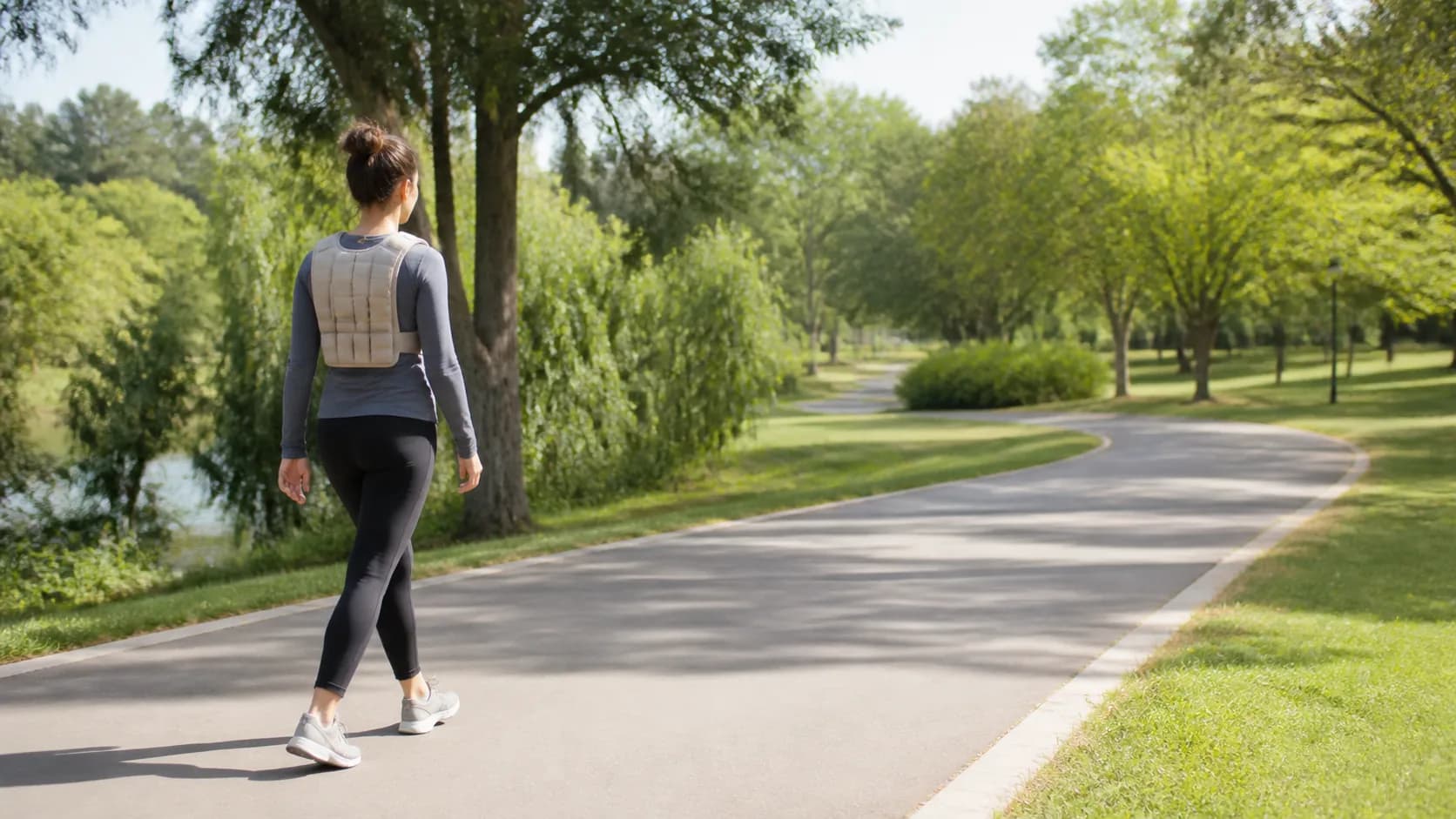
Do not add a heavy bag, weighted vest, speed challenge, or repeated descents at the same time. Increase frequency, number of flights, or pace one at a time after several comfortable sessions.
What stairs can and cannot measure
Stairs may make a short period feel hard, but the number of flights does not provide a universal measure of fitness or calories. Building layouts vary, devices detect floors differently, and holding rails or taking pauses changes the task. Use the activity as a practical movement opportunity, not an exact energy calculation.
If you track steps, remember that a short climb can be demanding without adding many steps. The broader pattern—regular walking, comfort on daily tasks, and whether you can recover—is more meaningful than a device total. Stepsly can help observe daily activity through Apple Health; it cannot determine whether every stair count or calorie estimate is exact.
Put stairs beside other movement
The general guidance is to move more and sit less, with aerobic activity and strength work across the week. Stairs can help break up a desk-bound day, but they do not need to replace flat walking, strength exercises, or rest. A useful week might include easy walks, ordinary flights when convenient, and one or two short intentional stair exposures if they feel good.
For a desk worker, the smallest habit can be powerful: take one safe flight after a meeting, then return to the elevator without guilt. For someone who lives in a walk-up, the goal may be pacing the existing stairs rather than adding extra repetitions. Build around the life you have.
When to stop and get help
Stop for chest pressure, fainting, severe shortness of breath, dizziness, sudden weakness, a fall, or sharp pain. New swelling, knee giving-way, repeated missteps, or pain that makes ordinary stairs difficult deserves assessment before more stair training. People with osteoporosis, a recent procedure, significant neuropathy, or known balance concerns should seek tailored guidance rather than use generic progression tables.
Practical questions about stairs
Do stairs count as walking? They contribute to movement, but they are a different demand than level walking. A flight can raise effort quickly and may add relatively few steps. Use it as a useful daily action, not as a precise conversion.
Should I skip the elevator every time? No. Choose stairs when they are safe, convenient, and fit your energy and mobility that day. An elevator may be the right decision when you have a heavy load, limited visibility, pain, fatigue, or an urgent need to arrive without exertion.
Can I use stairs for intervals? Only after ordinary climbs feel comfortable. A safer first interval is one controlled climb followed by several minutes of level recovery. Avoid racing, skipping steps, or holding a rail with both hands while moving quickly.
Why are stairs harder on some days? Sleep, heat, illness, medications, stress, a long day on your feet, and hydration can alter perceived effort. Treat a hard day as information, not a reason to force the same volume.
Turn a building feature into a reliable habit
Pick one predictable cue: a single flight after lunch, one floor before an elevator, or a controlled climb when arriving home. Keep the plan small enough that it does not create dread. When a cue becomes automatic, it may contribute more over a year than an occasional stair challenge.
If you work in a high-rise, consider the descent too. A climb that feels fine followed by many rushed flights down can be the part that irritates knees. Use a mixed route when it helps. The habit is about adding safe movement, not proving that you can avoid every elevator.
Review the plan after a few weeks
Ask whether stair use is becoming easier, whether you feel more confident using the rail and landings, and whether it is disrupting recovery from other activity. If the answer is yes, maintain the amount before adding anything. If the answer is no, reduce the number of climbs or switch to a level route. The point is to make a building feature support daily movement rather than create a recurring symptom.
A small positive habit can stay small. You do not need to turn a convenient stair into a workout circuit for it to be useful.
For additional planning context, see incline-walking benefits and walking-lunge benefits.
Sources, notes & disclaimers
-
Planning doses use the Physical Activity Guidelines for Americans (opens in a new tab): 150–300 moderate weekly minutes plus strength work on 2 days for most adults who can safely do so.
-
Regular movement, including moderate activity, contributes to overall health: U.S. Physical Activity Guidelines (opens in a new tab).
-
This article is general education. Use railings and appropriate footwear, and seek individualized guidance if pain, fall risk, dizziness, heart symptoms, or a condition affecting mobility makes stairs unsafe.