

How many steps should you walk per day? The answer is not 10,000 for everyone. Your ideal step count depends on your age, current fitness level, health goals, and lifestyle.
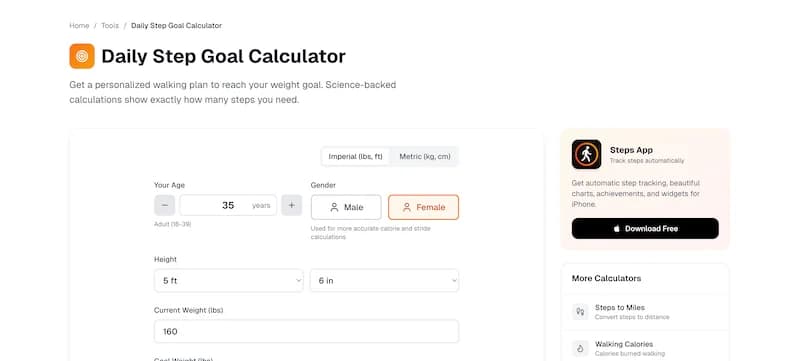
This guide will help you calculate a personalized step goal that actually makes sense for you. If you want a number right away, our Daily Step Goal Calculator builds one from your current steps, weight and goal weight; this guide explains the thinking behind a good goal.
Why One-Size-Fits-All Targets Do Not Work
The 10,000-step recommendation is everywhere, but it does not fit everyone.
The Problem With Universal Targets
A single number ignores:
- A 25-year-old athlete and a 70-year-old retiree have different needs
- Someone recovering from surgery cannot walk like a healthy person
- A construction worker already walks 15,000 steps at work
- A new mom with a baby has different constraints than a single professional
10,000 steps may be too easy for some and impossible for others.
What Research Actually Shows
Recent studies have refined our understanding:
- In older women (average age 72), about 4,400 steps a day was linked to lower death rates than about 2,700, and the benefit levelled off at around 7,500 steps a day (Lee et al., 2019 (opens in a new tab))
- In US adults aged 40 and older, 8,000 steps a day was linked to about half the risk of death of 4,000 steps a day (Saint-Maurice et al., 2020 (opens in a new tab))
- A 2025 meta-analysis linked 7,000 steps a day with 47% lower all-cause mortality than 2,000 steps, with benefits for several outcomes levelling off around 5,000 to 7,000 steps (Ding et al., 2025 (opens in a new tab))
- Where the benefit levels off depends on age (see below)
These are observational studies. They show that more steps are linked to better outcomes, not proof that steps alone caused the difference.
A 2022 meta-analysis of 15 cohorts with 47,471 adults found that the drop in death risk levelled off at about 6,000-8,000 steps a day for adults 60 and older, and about 8,000-10,000 steps a day for younger adults (Paluch et al., 2022 (opens in a new tab)).
The Personalized Approach
Instead of chasing an arbitrary number:
- Understand your current baseline
- Consider your age and health
- Define your specific goals
- Calculate a target that challenges but does not overwhelm
- Adjust based on results
This approach leads to sustainable habits and real progress.
Factors That Determine Your Ideal Step Count
Several factors influence your optimal daily steps.
Age
Research-based step ranges differ by age. The table below gives suggested starting ranges drawn from that research, not official guidelines. The US physical activity guidelines are written in minutes of activity, not steps, and describe 10,000 steps a day as "not a guideline per se" (Physical Activity Guidelines for Americans (opens in a new tab)).
| Age Group | Suggested Daily Steps |
|---|---|
| Children (6-12) | 11,000-15,000 |
| Teens (13-17) | 10,000-12,000 |
| Adults (18-40) | 8,000-10,000 |
| Adults (41-60) | 7,000-9,000 |
| Adults (60+) | 6,000-8,000 |
| Seniors (75+) | 4,000-6,000 |
The children's range reflects research estimating that 60 minutes of daily activity works out to roughly 11,000 to 15,000 steps for primary-school children (Tudor-Locke et al., 2011 (opens in a new tab)). The adult ranges sit close to where the benefit levelled off in the studies above. For a deeper look, see recommended steps per day by age. Your individual situation may vary.
Current Fitness Level
Your starting point matters:
| Current Activity Level | Realistic First Goal |
|---|---|
| Very sedentary (under 3,000) | 4,000-5,000 |
| Sedentary (3,000-5,000) | 6,000-7,000 |
| Lightly active (5,000-7,000) | 7,500-8,500 |
| Moderately active (7,000-10,000) | 9,000-10,500 |
| Active (10,000+) | Maintain or increase slightly |
Starting too high leads to burnout. Starting appropriately leads to success. If you're just getting going, see how many steps a beginner should aim for.
Health Goals
Different goals require different step counts:
General health maintenance:
- 7,000-8,000 steps daily
- Provides most health benefits
- Sustainable long-term
Weight loss:
- 10,000-12,000 steps daily
- Creates calorie deficit
- Combined with diet changes
Cardiovascular health:
- 7,000-10,000 steps daily
- Focus on consistency
- Some brisk walking helps
Mental health:
- 5,000-7,000 steps daily
- Outdoor walking preferred
- Consistency matters more than volume
Recovery or rehabilitation:
- Start very low (1,000-3,000)
- Increase gradually per medical advice
- Focus on consistency over volume
Lifestyle and Occupation
Your daily life affects your target:
Desk job:
- Need intentional walking
- Target: Add 5,000-7,000 steps beyond baseline
Active job (retail, nursing):
- Already walking at work
- May only need 2,000-3,000 additional steps
Very active job (construction, delivery):
- May already exceed 10,000 steps
- Focus on recovery and consistency
Stay-at-home parent:
- Variable activity
- Target: Consistent daily walking time
Physical Limitations
Adjust for health conditions:
- Arthritis: Lower targets, focus on consistency
- Heart conditions: Follow medical advice
- Obesity: Start low, progress gradually
- Recent surgery: Follow rehabilitation guidelines
- Chronic fatigue: Very low targets, gradual increase
Always consult a doctor if you have health concerns.
Step-by-Step Personal Calculation
Here is how to calculate your ideal step goal.
Step 1: Find Your Baseline
Track your steps for one week without changing behavior:
- Wear your phone or tracker normally
- Do not try to walk more
- Record daily totals
- Calculate your average
Example:
- Week total: 28,000 steps
- Average: 4,000 steps per day
- This is your baseline
Step 2: Apply Age Adjustment
Based on your age, identify your target range:
- Age 35: Target range 8,000-10,000
- Age 55: Target range 7,000-9,000
- Age 70: Target range 6,000-8,000
Step 3: Consider Your Goal
Adjust based on what you want to achieve:
- Maintenance: Middle of age range
- Weight loss: Upper end of age range, plus up to 1,000-2,000 more once that feels manageable
- Recovery: Lower end of age range or below
Step 4: Account for Limitations
Reduce target if you have:
- Joint pain: Reduce by 1,000-2,000
- Chronic conditions: Reduce by 2,000-3,000
- Very low baseline: Start with baseline + 1,500
Step 5: Calculate Your First Goal
Formula: First Goal = Baseline + Reasonable Increase
Reasonable increases:
- Very sedentary: +1,000 to +1,500
- Sedentary: +1,500 to +2,000
- Lightly active: +1,500 to +2,500
- Moderately active: +1,000 to +2,000
Example calculation:
- Baseline: 4,000 steps
- Age 45 (range 7,000-9,000), goal is weight loss
- Target: 9,000, rising toward 10,000-11,000 later
- First goal: 4,000 + 1,500 = 5,500 steps
Your first goal should feel challenging but achievable. If you hit it easily for two weeks, increase. If you struggle to hit it, reduce slightly.
Step 6: Plan Your Progression
Map out how you will reach your ultimate target:
Example progression (baseline 4,000, target 8,000):
| Weeks | Daily Goal |
|---|---|
| 1-2 | 5,500 |
| 3-4 | 6,000 |
| 5-6 | 6,500 |
| 7-8 | 7,000 |
| 9-10 | 7,500 |
| 11-12 | 8,000 |
This gradual approach takes 12 weeks but builds sustainable habits. The US physical activity guidelines suggest a similar pace: someone starting at about 5,000 steps a day might add 500 steps a day each week, while people who are less fit or starting lower should add a smaller number (Physical Activity Guidelines for Americans (opens in a new tab)).
Sample Calculations for Different Profiles
Here are examples for different situations.
Profile 1: Sedentary Office Worker
Details:
- Age: 35
- Baseline: 3,500 steps
- Goal: Weight loss
- No health issues
Calculation:
- Age range: 8,000-10,000
- Weight loss: Upper end (10,000)
- First goal: 3,500 + 1,500 = 5,000
- Ultimate target: 10,000 steps
Timeline: 16-20 weeks to reach target
Profile 2: Active Retiree
Details:
- Age: 68
- Baseline: 5,500 steps
- Goal: Heart health
- Mild knee arthritis
Calculation:
- Age range: 6,000-8,000
- Heart health: Middle (7,000)
- Knee adjustment: -500
- First goal: 5,500 + 1,000 = 6,500
- Ultimate target: 6,500-7,000 steps
Timeline: 4-6 weeks to reach target
Profile 3: Busy Parent
Details:
- Age: 42
- Baseline: 6,000 steps
- Goal: General health, stress relief
- No health issues, limited time
Calculation:
- Age range: 7,000-9,000
- General health: Middle (8,000)
- First goal: 6,000 + 1,500 = 7,500
- Ultimate target: 8,000 steps
Timeline: 6-8 weeks to reach target
Profile 4: Post-Surgery Recovery
Details:
- Age: 50
- Baseline: 1,500 steps (post-surgery)
- Goal: Rebuild fitness
- Following doctor's guidelines
Calculation:
- Age range: 7,000-9,000
- Recovery: Start very low
- First goal: 1,500 + 500 = 2,000
- Ultimate target: Work toward 6,000-7,000 over 6+ months
Timeline: 6-12 months, following medical advice
Using Data to Refine Your Target
Your initial calculation is a starting point. Refine it based on results.
Weekly Review
Each week, ask:
- Did I hit my goal most days?
- How did I feel physically?
- Was it too easy or too hard?
- Am I making progress toward my ultimate target?
Adjustment Rules
Increase goal if:
- You hit your goal 6-7 days per week
- It feels too easy
- You have energy to spare
- No pain or excessive fatigue
Maintain goal if:
- You hit your goal 4-5 days per week
- It feels challenging but doable
- You are adapting well
Decrease goal if:
- You hit your goal fewer than 4 days
- You feel exhausted or in pain
- You dread walking
- Life circumstances changed
Long-Term Tracking
When to Recalculate
Recalculate your target when:
- You reach your current target consistently
- Your goals change
- Your health status changes
- Your lifestyle changes significantly
- You have been at the same level for 3+ months
Common Mistakes to Avoid
Here are pitfalls that derail progress.
Starting Too High
Problem: Jumping straight to 10,000 steps Result: Burnout, injury, quitting Solution: Start at baseline + 1,500
Comparing to Others
Problem: Trying to match a friend's step count Result: Frustration, unrealistic expectations Solution: Focus on your own progress
Ignoring Pain Signals
Problem: Pushing through joint or muscle pain Result: Injury, forced rest, setback Solution: Reduce goal, rest, consult doctor if needed
Obsessing Over Daily Numbers
Problem: Stressing about hitting exact target every day Result: Anxiety, negative relationship with walking Solution: Focus on weekly averages
Never Adjusting
Problem: Keeping the same goal forever Result: Plateau, boredom, no progress Solution: Review and adjust every 4-6 weeks
If walking causes sharp pain, severe shortness of breath, or dizziness, stop immediately and consult a healthcare provider. These are not normal responses to walking.
Quick Reference Calculator
Use this simplified calculator:
Your Personal Step Target
-
Find your baseline: Track for 1 week = ______ steps
-
Identify your age range:
- 18-40: 8,000-10,000
- 41-60: 7,000-9,000
- 60+: 6,000-8,000
-
Adjust for goal:
- Weight loss: Upper end of range, plus up to 1,000-2,000
- Maintenance: Middle of range
- Recovery: -1,000-2,000
-
Adjust for limitations:
- Joint issues: -1,000
- Chronic conditions: -1,000-2,000
- Very low baseline: Start with baseline + 1,000
-
Calculate first goal:
- Baseline + 1,500 = First goal
-
Calculate ultimate target:
- Age range ± goal adjustment ± limitation adjustment
Example Quick Calculation
- Baseline: 4,500
- Age: 45 (range 7,000-9,000)
- Goal: Weight loss (upper end, 9,000, plus up to 1,500)
- No limitations
- First goal: 4,500 + 1,500 = 6,000
- Ultimate target: 9,000-10,500
The Bottom Line
Your ideal daily step count is personal. It depends on your age, current fitness, goals, and health status. The 10,000-step target is not wrong, but it is not right for everyone.
Key takeaways:
- One-size-fits-all targets do not work
- Start by finding your actual baseline
- Consider age, goals, and limitations
- Set a first goal that is challenging but achievable
- Progress gradually (add 500-1,000 steps every 2 weeks)
- Review and adjust based on real results
- Focus on weekly trends, not daily perfection
Your perfect step count is the one you can hit consistently while making progress toward your goals. Calculate it, pursue it, and adjust as you grow.
References
- JAMA Internal Medicine: Association of Step Volume and Intensity With All-Cause Mortality in Older Women (Lee et al., 2019) (opens in a new tab)
- JAMA: Association of Daily Step Count and Step Intensity With Mortality Among US Adults (Saint-Maurice et al., 2020) (opens in a new tab)
- The Lancet Public Health: Daily steps and all-cause mortality, a meta-analysis of 15 international cohorts (Paluch et al., 2022) (opens in a new tab)
- The Lancet Public Health: Daily steps and health outcomes in adults, a systematic review and dose-response meta-analysis (Ding et al., 2025) (opens in a new tab)
- International Journal of Behavioral Nutrition and Physical Activity: How many steps/day are enough? For children and adolescents (Tudor-Locke et al., 2011) (opens in a new tab)
- U.S. Department of Health and Human Services: Physical Activity Guidelines for Americans, 2nd edition (2018) (opens in a new tab)
- CDC: Physical Activity Guidelines for Americans (opens in a new tab)
- Harvard Health: How Many Steps Per Day (opens in a new tab)
- Mayo Clinic: Walking for Fitness (opens in a new tab)