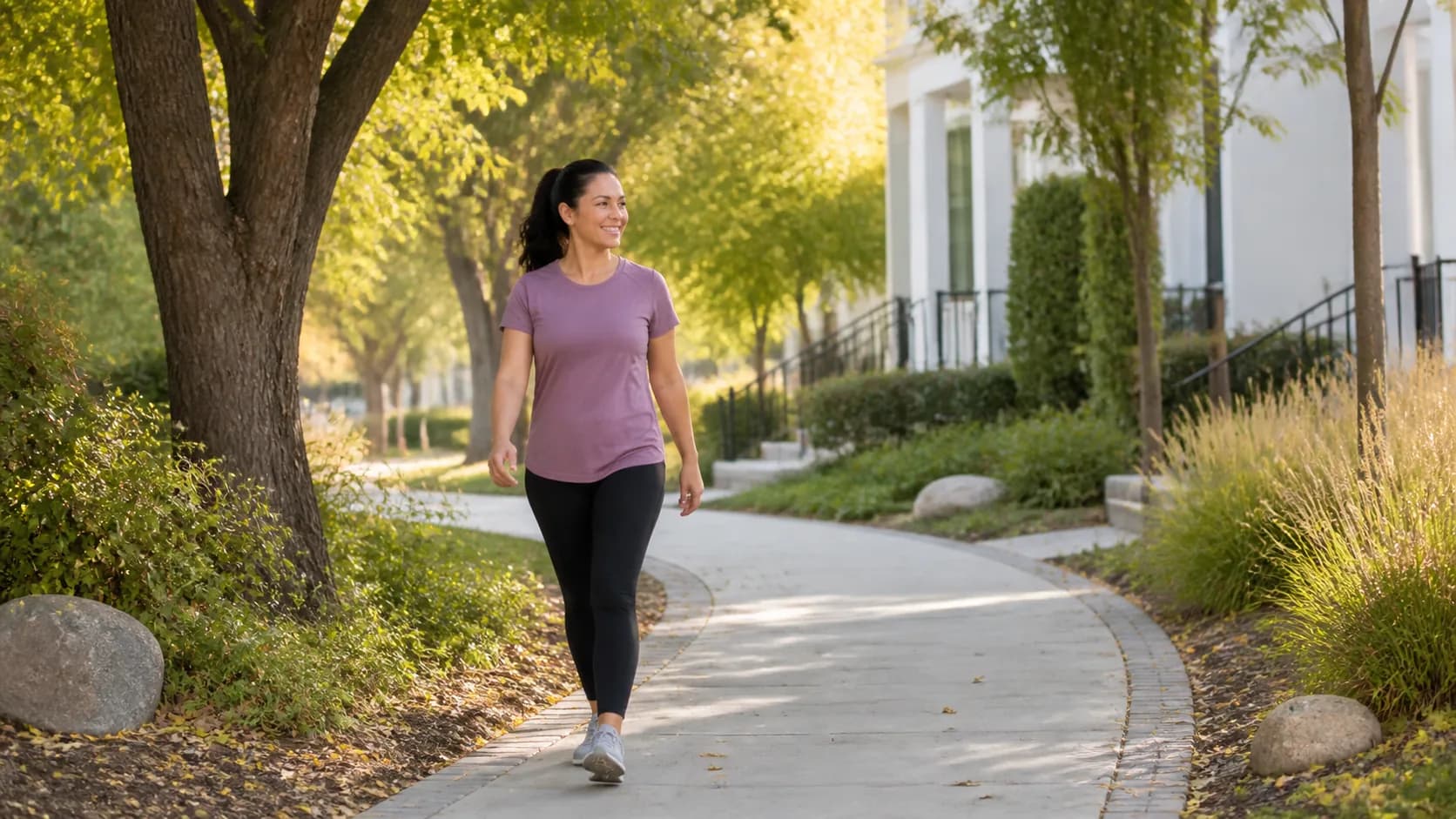
Brisk walking starts at about 100 steps per minute. In lab studies of healthy adults aged 21 to 60, that cadence lined up with moderate intensity (3 METs, or three times your resting energy use), and about 130 steps per minute lined up with vigorous intensity (6 METs). In between, every extra 10 steps a minute added roughly 1 MET: about 110 steps per minute for 4 METs and 120 for 5 METs. In adults aged 61 to 85, the same 100, 110 and 120 marks held, but too few people reached vigorous intensity to set a 130 mark.
To check your own cadence, count your steps for 15 seconds and multiply by 4. Twenty-five steps or more (100 a minute) puts you at a brisk pace by the research rule of thumb. In the model our calculators use, a 5'9" walker reaches 100 steps per minute at about 2.4 mph and takes about 111 steps per minute at 3 mph.
How many steps per minute is brisk walking?
A 2018 review of 38 cadence studies (opens in a new tab) concluded that, despite real differences between people, at least 100 steps per minute is a consistent rule of thumb for moderate-intensity walking in adults.
The CADENCE-Adults studies then tested it by age group, hand-counting steps and measuring oxygen use as healthy adults walked faster and faster on a treadmill. Their rounded thresholds:
| Intensity | Ages 21–40 (2019) | Ages 41–60 (2020) | Ages 61–85 (2021) |
|---|---|---|---|
| Moderate begins (3 METs) | 100 steps/min | 100 steps/min | 100 steps/min |
| 4 METs | 110 steps/min | 110 steps/min | 110 steps/min |
| 5 METs | 120 steps/min | 120 steps/min | 120 steps/min |
| Vigorous begins (6 METs) | 130 steps/min | 130 steps/min | No threshold set |
Sources: ages 21–40 (opens in a new tab) (110 and 120 marks in the full text (opens in a new tab)), ages 41–60 (opens in a new tab) (full text (opens in a new tab)) and ages 61–85 (opens in a new tab). In the oldest group, only 6 of 98 participants reached 6 METs, so no vigorous threshold was set.
Before rounding, the estimates for 3 METs ran from about 96 to 103 steps per minute, depending on age group and statistical method. For context, the U.S. guidelines define moderate activity as 3.0 to just under 6.0 METs, give "walking briskly (2.5 to 4 mph)" as an example, and put vigorous activity at 6.0 METs or more (Physical Activity Guidelines for Americans (opens in a new tab), page 20).
When 100 feels too easy
Those thresholds are about energy use, not how hard the walk feels to you. A separate CADENCE-Adults analysis (opens in a new tab) used heart rate and perceived effort instead. After a published correction (opens in a new tab), its moderate-intensity thresholds were at least 120 steps per minute for ages 21–30, 120 for 31–40, 115 for 41–50 and 110 for 51–60. So if you're younger and fit, 100 steps per minute may feel easy.
Does height change your walking cadence?
Probably, yes. In Rowe et al. (2011) (opens in a new tab), 75 adults walked at three speeds on a treadmill and over ground. Height explained walking intensity at a given cadence as well as leg length or stride length did. The cadence that matched moderate intensity ranged from 113 steps per minute at 152 cm (5'0") down to 90 at 198 cm (6'6"), though the authors still supported 100 as a simple public health message.
The CADENCE-Adults team found a smaller effect: in the 21–40 group, adding leg length to the model barely changed its predictions (full text (opens in a new tab)).
The practical reading: tall walkers may reach moderate intensity a little below 100 steps per minute, and short walkers a little above it. In our model, a 5'0" walker at 113 steps per minute and a 6'6" walker at 90 are both moving at about 2.3 to 2.5 mph, close to the 2.5 mph the guidelines use for brisk walking. Cadence is largely a handy stand-in for speed.
Steps per minute by walking speed and height
This table uses the model behind our calculators. At 3 mph, step length is estimated at 41.4% of your height (a rule of thumb, not a measurement), and steps get a little longer as you speed up.
| Pace | Speed | Minutes per mile | 5'2" | 5'9" | 6'2" |
|---|---|---|---|---|---|
| Slow | 2.0 mph (3.2 km/h) | 30:00 | 101 | 91 | 84 |
| Easy | 2.5 mph (4.0 km/h) | 24:00 | 113 | 101 | 94 |
| Moderate | 3.0 mph (4.8 km/h) | 20:00 | 123 | 111 | 103 |
| Brisk | 3.5 mph (5.6 km/h) | 17:09 | 133 | 120 | 112 |
| Very brisk | 4.0 mph (6.4 km/h) | 15:00 | 143 | 128 | 119 |
| Very fast | 4.5 mph (7.2 km/h) | 13:20 | 151 | 136 | 127 |
Cadences are steps per minute, rounded. By this model, a 5'9" walker passes 100 steps per minute at about 2.4 mph and 130 at just over 4 mph. A 5'2" walker gets there at about 2.0 and 3.3 mph, and a 6'2" walker at about 2.8 and 4.7 mph. That spread is why the 100 mark can flatter shorter walkers and shortchange taller ones.
The walking pace calculator converts speed to minutes per mile or kilometer, and the stride length calculator swaps the rule of thumb for your own step length.
How do you measure your walking cadence?
You don't need a device. Count your steps for a full minute, or for 15 seconds and multiply by 4, or for 10 seconds and multiply by 6 (Tudor-Locke et al., 2018 (opens in a new tab)).
- Walk for a few minutes on flat ground at the pace you want to check.
- Start a timer and count every footfall, left and right.
- Stop at 15 seconds and multiply by 4, or at 30 seconds and multiply by 2.
- Repeat two or three times and average.
In a 15-second count, 25 steps is 100 a minute, 28 is about 110, 30 is 120 and 33 is about 130.
You can also divide a walk's total steps by its minutes: 3,000 steps in 30 minutes is 100 steps per minute. Stops pull that average below your moving cadence. For an iPhone version over a 10-minute walk, see how many steps are in a 1-hour walk. The same review notes that a metronome or music can help set cadence: stepping on every beat of a 120 BPM song is 120 steps per minute.
Can your iPhone show your walking cadence?
Not directly, as far as Apple's documentation goes. Apple's examples of the mobility metrics iPhone 8 or later measures for Health are walking speed, double support time, step length and walking asymmetry (About iOS 14 Updates (opens in a new tab)), and its documentation doesn't describe a walking cadence metric. Apple Watch shows "running cadence" during Outdoor Run workouts (Apple Support (opens in a new tab)), but that's for running.
You can estimate cadence from two of those metrics. Apple says walking speed (opens in a new tab) and walking step length (opens in a new tab) are averages recorded while you walk steadily on flat ground with your iPhone near your waist, such as in a pocket, and that your height in Health should be up to date.
- Imperial: steps per minute ≈ walking speed (mph) × 1,056 ÷ step length (inches)
- Metric: steps per minute ≈ walking speed (km/h) × 1,667 ÷ step length (cm)
For example, 3.0 mph with a 28-inch step length is about 113 steps per minute. To find both numbers, open Health, tap Browse and search for "Walking Speed" or "Walking Step Length" (Apple Support (opens in a new tab)). These are everyday averages, so the result reflects your usual steady walking, not necessarily a dedicated brisk walk.
Counting also fills a gap: without an Apple Watch, the Fitness app on iPhone shows only the Move ring, not the Exercise ring that tracks minutes of brisk activity (Apple Support (opens in a new tab)).
How to use cadence to make your walks count
The U.S. guidelines say adults need at least 150 to 300 minutes a week of moderate-intensity aerobic activity, "like brisk walking or fast dancing," and the second edition dropped the old rule that only 10-minute bouts counted (Top 10 Things to Know (opens in a new tab)). The full guidelines allow 75 to 150 minutes of vigorous activity, or an equivalent mix, instead (page 8).
- Aim for 100 or more. By the rule of thumb, minutes at 100+ steps per minute are moderate for most adults. Marshall et al. (2009) (opens in a new tab) turned this into a goal of at least 3,000 steps in 30 minutes on 5 days a week, or three 10-minute bouts of 1,000 steps a day.
- Do the weekly math. 150 minutes at 100 steps per minute is 15,000 steps a week; at 120 it's 18,000, on top of your everyday steps. For time-based totals, see how many steps are in 30 minutes of walking.
- Step up to 110 or 120 once 100 feels comfortable. They matched 4 and 5 METs in every CADENCE-Adults age group.
- Check the talk test. At moderate intensity you can talk but not sing; at vigorous intensity you can't say more than a few words without pausing for breath. Older or less fit adults may find moderate activities feel vigorous (guidelines, page 59). If the count and your breathing disagree, ease off. For steady effort, see zone 2 walking.
What cadence can't tell you
- It's a group average. The CADENCE-Adults authors note that a rounded threshold has limited precision for any one person.
- It comes from level treadmill walking. Hills, stairs, rough ground and carrying a load all change effort, and the thresholds don't account for them.
- Step length matters too. Speed is cadence times step length, and people mix the two differently as they speed up (Tudor-Locke et al., 2018 (opens in a new tab)). Quicker, shorter steps raise your count without necessarily making you faster.
- It isn't a health assessment. If you have a heart condition, are pregnant, take medicine that affects heart rate, or are recovering from illness or surgery, ask a clinician what effort suits you. Stop and get help for chest pain, dizziness or unusual shortness of breath.
See your brisk walks hour by hour
Questions people ask
Is 100 steps per minute a brisk walk?
Yes, by the research rule of thumb. In the CADENCE-Adults studies, 100 steps per minute matched moderate intensity (3 METs) in every age group from 21 to 85. Tall walkers may get there a little below 100, and shorter walkers a little above.
How many steps per minute is 3 mph?
In our model, about 111 steps per minute at 5'9", 123 at 5'2" and 103 at 6'2". All three are above the 100 mark for moderate intensity.
How many steps per minute is a 15-minute mile?
A 15-minute mile is 4 mph: about 128 steps per minute at 5'9" in our model, 143 at 5'2" and 119 at 6'2". In a 15-second count, about 32 steps is 128 a minute.
How many steps per minute is vigorous walking?
About 130 steps per minute matched vigorous intensity (6 METs) in adults aged 21 to 60. No vigorous threshold was set for ages 61 to 85. In our model, a 5'9" walker reaches 130 at just over 4 mph.
What is a good walking cadence for older adults?
For adults 61 to 85, CADENCE-Adults found the same marks as in younger adults: 100 steps per minute for 3 METs, 110 for 4 METs and 120 for 5 METs. Because moderate activity can feel vigorous to older or less fit adults, build up gradually and let how you feel guide you.
Sources, notes & disclaimers
- How fast is fast enough? Walking cadence (steps/min) as a practical estimate of intensity in adults: a narrative review (opens in a new tab) — Tudor-Locke C, et al., Br J Sports Med, 2018 (full text (opens in a new tab)).
- Walking cadence (steps/min) and intensity in 21-40 year olds: CADENCE-adults (opens in a new tab) — Tudor-Locke C, et al., Int J Behav Nutr Phys Act, 2019 (full text (opens in a new tab)).
- Walking cadence (steps/min) and intensity in 41 to 60-year-old adults: the CADENCE-adults study (opens in a new tab) — Tudor-Locke C, et al., Int J Behav Nutr Phys Act, 2020 (full text (opens in a new tab)).
- Walking cadence (steps/min) and intensity in 61-85-year-old adults: the CADENCE-Adults study (opens in a new tab) — Tudor-Locke C, et al., Int J Behav Nutr Phys Act, 2021.
- Cadence (steps/min) and relative intensity in 21 to 60-year-olds: the CADENCE-adults study (opens in a new tab) — McAvoy CR, et al., Int J Behav Nutr Phys Act, 2021, and its 2022 correction (opens in a new tab).
- Stride rate recommendations for moderate-intensity walking (opens in a new tab) — Rowe DA, et al., Med Sci Sports Exerc, 2011.
- Translating physical activity recommendations into a pedometer-based step goal: 3000 steps in 30 minutes (opens in a new tab) — Marshall SJ, et al., Am J Prev Med, 2009.
- Top 10 Things to Know About the Second Edition of the Physical Activity Guidelines for Americans (opens in a new tab) — U.S. Office of Disease Prevention and Health Promotion.
- Physical Activity Guidelines for Americans, 2nd edition (opens in a new tab) — U.S. Department of Health and Human Services, 2018 (pages 8, 20 and 59).
- Photo: lena Enz on Unsplash (opens in a new tab).
- Apple: About iOS 14 Updates (opens in a new tab), View your data in Health on iPhone (opens in a new tab), See your activity summary in Fitness on iPhone (opens in a new tab), Workout views and running metrics on Apple Watch (opens in a new tab), and HealthKit documentation for walking speed (opens in a new tab) and walking step length (opens in a new tab).
About the numbers. The cadence table and crossing speeds come from the walking model behind our calculators (step length 41.4% of height at 3 mph, growing with the square root of speed); your measured cadence will differ. Stepsly details follow its App Store listing for version 4.0, checked October 27, 2026.
Disclaimer. This article is general information, not medical advice. Cadence thresholds come from lab studies of healthy adults and may not fit you. Talk to a qualified clinician before starting or changing an exercise routine if you have a health condition.